
Origami: crease patterns and folding
Draw a crease pattern on a flat sheet, mark each crease mountain, valley or cut, and fold it: by angles you give, by a variable you slide, with the other creases solved. Check the pattern's vertices, and export the pattern for printing or cutting.
A sheet and its creases
A fold starts from a sketch: a closed outline of straight lines is the sheet (holes are allowed), and
straight lines inside it are the creases. Draw the creases as construction lines
("construction": true), so the sketch stays a plain outline for anything else that uses it. Each crease
in feature.fold says which line it is (its entity id from sketch.line), its kind and, if you like,
its angle:
| Kind | Seen from the front (the side the sketch's normal points to) |
|---|---|
valley |
the paper folds towards you; the crease sinks |
mountain |
the paper folds away from you; the crease rises |
cut |
the sheet is cut through along the line |
A crease runs from the boundary, a cut or another crease to the boundary, a cut or another crease. Where creases cross or end on each other is a vertex; the creases divide the sheet into facets, and each facet stays flat and turns about the creases it shares with its neighbours. That is rigid folding: the paper does not bend or stretch between the creases.
One fold, driven by a variable
A card folded in two, by the variable fold:
[
  ["file.new", {"units": "mm"}],
  ["variable.set", {"name": "fold", "expr": "60 deg"}],
  ["sketch.create", {"plane": "xy", "name": "Paper"}],
  ["sketch.polyline", {"sketch": "Paper", "points": [[0, 0], [100, 0], [100, 100], [0, 100]], "closed": true}],
  ["sketch.line", {"sketch": "Paper", "from": [50, 0], "to": [50, 100], "construction": true}],
  ["feature.fold", {"sketch": "Paper", "name": "Card", "fixed": [25, 50],
    "creases": [{"line": "e11", "kind": "valley", "angle": "fold"}]}]
]
The angle is a fold angle: 0 is flat, 180 degrees is folded flat, and the kind says which way. fixed is
a point inside the facet that stays where it is (without it, the largest facet stays). Change fold with
variable.set, or make it a parameter and drag its slider, and the card opens and closes. The result is a
sheet (no volume, see Modelling features): document.measure gives its area, still
100 × 100 mm², whatever the angle.
Solved creases: a vertex with four creases
Leave a crease's angle out and 3DCraft solves it: the facets round every vertex must meet again, which fixes the angles of the others. A vertex with four creases has one degree of freedom, so one angle drives all four. Here the creases leave the middle at 0, 60, 120 and 240 degrees:
[
  ["file.new", {"units": "mm"}],
  ["variable.set", {"name": "drive", "expr": "40 deg"}],
  ["sketch.create", {"plane": "xy", "name": "Vertex"}],
  ["sketch.polyline", {"sketch": "Vertex", "points": [[-50, -50], [50, -50], [50, 50], [-50, 50]], "closed": true}],
  ["sketch.line", {"sketch": "Vertex", "from": [0, 0], "to": [50, 0], "construction": true}],
  ["sketch.line", {"sketch": "Vertex", "from": [0, 0], "to": [28.867513459481287, 50], "construction": true}],
  ["sketch.line", {"sketch": "Vertex", "from": [0, 0], "to": [-28.867513459481287, 50], "construction": true}],
  ["sketch.line", {"sketch": "Vertex", "from": [0, 0], "to": [-28.867513459481287, -50], "construction": true}],
  ["feature.fold", {"sketch": "Vertex", "name": "Twist", "creases": [
    {"line": "e11", "kind": "valley", "angle": "drive"},
    {"line": "e14", "kind": "mountain"},
    {"line": "e17", "kind": "valley"},
    {"line": "e20", "kind": "valley"}]}],
  ["fold.inspect", {"fold": "Twist"}]
]
fold.inspect lists every crease with the angle each of its pieces folds by: at a drive of 40 degrees the
crease opposite the driving one folds by 40 degrees too, and the two others by about 20.6 degrees, one up
and one down. This is the closed form of such a vertex (Huffman; Tachi): tan(ρ₂/2) = −½ tan(ρ₁/2) here.
The kinds choose how the vertex folds: marked the other way round, it would fold another way, or not at
all.
When a fold cannot be made, the feature fails and says why:
- not rigidly foldable at these angles: the angles you gave cannot all hold; give fewer, and let the others be solved;
- nothing determines the fold angles of …: too few angles are given (a crease on no closed loop of creases, or a vertex with more than four creases and one angle); give those creases an angle;
- would fold the other way from its kind: at these angles the pattern only folds with that crease turned the other way;
- pass through each other or lie on each other: two facets meet. Below 180 degrees a sheet without thickness may not touch itself; at exactly 180 degrees it is folded flat (next section), where facets lie on one another in an order of layers;
- folds by 180 degrees while other creases fold by less: a crease at 180 degrees beside creases given 0 only. Give the others an angle (a stack folded on, below), every crease 180 degrees, or leave the zeros out.
Folding flat
Give the creases 180 degrees and the sheet is folded flat: every facet comes down onto the plane of the sketch, face over, and many lie on top of one another. A crease without an angle then folds by 180 degrees too, the way its kind says. The question is no longer the angles but the order of the layers: which facet lies above which, so that no facet passes through another. 3DCraft works it out:
- two facets joined by a crease are ordered by its kind: seen from the front, a valley brings their fronts together, a mountain their backs;
- a facet that lies across a fold may not slip between the fold's two facets (taco-tortilla);
- two folds along the same line nest or stay apart, never interleave (taco-taco);
- three facets that lie on one spot are in one order there (transitivity).
These are the published rules for flat-folded states (Justin; Bern and Hayes; Akitaya, Demaine and Ku). Here is the waterbomb base of the next section, folded flat:
[
  ["file.new", {"units": "mm"}],
  ["sketch.create", {"plane": "xy", "name": "Square"}],
  ["sketch.polyline", {"sketch": "Square", "points": [[-50, -50], [50, -50], [50, 50], [-50, 50]], "closed": true}],
  ["sketch.line", {"sketch": "Square", "from": [-50, 0], "to": [50, 0], "construction": true}],
  ["sketch.line", {"sketch": "Square", "from": [-50, -50], "to": [50, 50], "construction": true}],
  ["sketch.line", {"sketch": "Square", "from": [50, -50], "to": [-50, 50], "construction": true}],
  ["feature.fold", {"sketch": "Square", "name": "Base", "creases": [
    {"line": "e11", "kind": "mountain", "angle": "180 deg"},
    {"line": "e14", "kind": "valley"},
    {"line": "e17", "kind": "valley"}]}],
  ["fold.inspect", {"fold": "Base"}]
]
fold.inspect says flat: true and gives the layers: per facet its layer (0 has nothing below it) and
faceDown, and under layers.above every pair of facets that overlap, upper first. The body itself lies
exactly in the sketch's plane (document.measure gives the area of the square, 100 × 100 mm², as always);
only the picture lifts each layer a little off the one below it, so that you can see them.
When the kinds do not fold flat, the feature fails and says so: cannot fold flat with this mountain-valley assignment, naming the facets that cannot be layered (mark all three creases valleys and try), or does not fold flat when the facets round a vertex do not meet again (Kawasaki fails there). Deciding whether a crease pattern folds flat is a hard problem in general (NP-hard), so the search for an order has a limit; past it the fold fails with not decided within the work allowed, never a guess.
One honest note: a pattern that folds flat need not be reachable by rigid folding, with the facets staying flat all the way. Sliding a fold's angle towards 180 degrees may stop short (the fold cannot be followed, or two facets touch) while the flat state at exactly 180 degrees exists.
Creases from a sketch pattern
A crease line that a sketch pattern copies (sketch.pattern) gives creases of its copies too: name one
copy as the sketch names it, e11[1], or the line and every copy with e11[*]. With "alternate": true the kinds alternate along the copies, the given kind on the line itself: a pleat (accordion) whose
number of folds is a variable:
[
  ["file.new", {"units": "mm"}],
  ["variable.set", {"name": "n", "expr": "4"}],
  ["variable.set", {"name": "a", "expr": "30 mm"}],
  ["variable.set", {"name": "fold", "expr": "40 deg"}],
  ["sketch.create", {"plane": "xy", "name": "Strip"}],
  ["sketch.polyline", {"sketch": "Strip", "points": [["0 mm", "0 mm"], ["n * a", "0 mm"], ["n * a", "a"], ["0 mm", "a"]], "closed": true}],
  ["sketch.line", {"sketch": "Strip", "from": ["a", "0 mm"], "to": ["a", "a"], "construction": true}],
  ["sketch.pattern", {"sketch": "Strip", "entities": ["e11"], "count": "n - 1", "step": ["a", "0 mm"]}],
  ["feature.fold", {"sketch": "Strip", "name": "Pleats", "fixed": [15, 15], "creases": [
    {"line": "e11[*]", "kind": "valley", "angle": "fold", "alternate": true}]}],
  ["fold.inspect", {"fold": "Pleats"}]
]
fold.inspect lists e11 (valley), e11[1] (mountain) and e11[2] (valley); set fold to 180 deg
and the strip lies flat in four layers. A crease that names one copy (e11[1] with its own kind or angle,
through fold.edit with set) wins over e11[*] for that copy. A crease line whose copies are not all
creases is refused, naming the copies left out: they would otherwise be dropped without a word. A copy is
named by its number; there is no e11[last], because a name must keep naming the same line when the
pattern's count changes (draw the last one as a line of its own if it needs another kind).
Checking a crease pattern: Kawasaki and Maekawa
fold.check looks at every vertex inside the sheet and tells you, for each, two classic conditions for
folding flat:
- Kawasaki: going round the vertex, the angles between the creases, taken alternately, add up to 180 degrees each;
- Maekawa: the numbers of mountains and of valleys at the vertex differ by exactly 2.
For each vertex you get where it is, its creases, both sums and how far off they are, and the numbers of
mountains and valleys. These are two small, local checks, and they are honest about what they do not
say: a vertex that fails either one cannot fold flat, but passing both at every vertex does not prove
that the whole pattern folds flat. Whether a crease pattern folds flat is a hard problem in general
(NP-hard, Bern and Hayes 1996), and 3DCraft does not claim to answer it. The result repeats this in its
note.
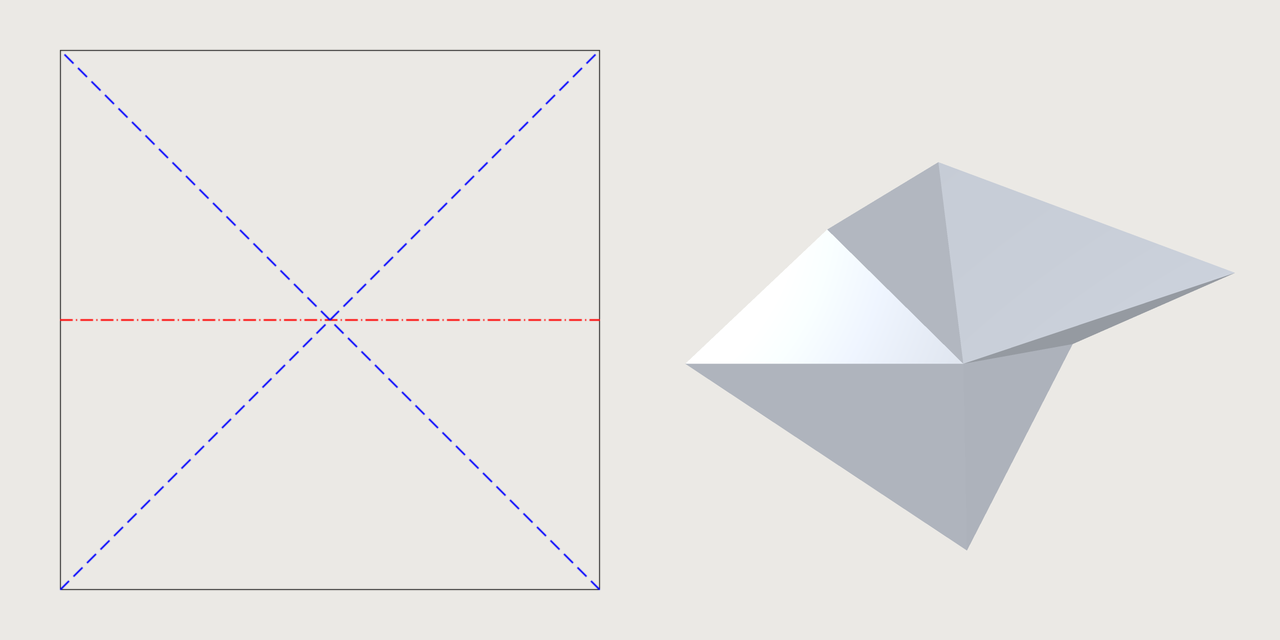
The waterbomb base, both diagonals valleys and one middle line a mountain, passes both checks at its one vertex:
[
  ["file.new", {"units": "mm"}],
  ["sketch.create", {"plane": "xy", "name": "Square"}],
  ["sketch.polyline", {"sketch": "Square", "points": [[-50, -50], [50, -50], [50, 50], [-50, 50]], "closed": true}],
  ["sketch.line", {"sketch": "Square", "from": [-50, 0], "to": [50, 0], "construction": true}],
  ["sketch.line", {"sketch": "Square", "from": [-50, -50], "to": [50, 50], "construction": true}],
  ["sketch.line", {"sketch": "Square", "from": [50, -50], "to": [-50, 50], "construction": true}],
  ["feature.fold", {"sketch": "Square", "name": "Waterbomb", "creases": [
    {"line": "e11", "kind": "mountain", "angle": "36.03846874550981 deg"},
    {"line": "e14", "kind": "valley", "angle": "49.40777113928209 deg"},
    {"line": "e17", "kind": "valley"}]}],
  ["fold.inspect", {"fold": "Waterbomb"}],
  ["fold.check", {"fold": "Waterbomb"}],
  ["file.export", {"path": "waterbomb.svg", "fold": "Waterbomb"}]
]
A vertex with six creases has three degrees of freedom, so it needs three angles: here the middle line
(both of its halves) and one diagonal are given, and fold.inspect gives the other diagonal: 49.41
degrees for both halves, as the base's symmetry says. Give fewer, or none at all, and the fold fails with
nothing determines the fold angles of …: a crease pattern with solved creases folds only when the
angles you give decide how (even the flat sheet, with every given angle 0, does not decide which way the
others would go). fold.check and the export only read the pattern, so they work whether the fold
does or not.
The same checks are assertion measures, so a crease pattern made from variables can be held to them:
kawasakiFails and maekawaFails count the interior vertices that fail (assert eq 0), and
flatFoldable says whether the pattern with its kinds folds flat (every crease at 180 degrees, with an
order of the layers), whatever angles the fold has now:
[
  ["assert.add", {"name": "Kawasaki holds at every interior vertex", "measure": "kawasakiFails", "of": "Waterbomb", "eq": "0"}],
  ["assert.add", {"name": "Maekawa holds at every interior vertex", "measure": "maekawaFails", "of": "Waterbomb", "eq": "0"}],
  ["assert.add", {"name": "It folds flat", "measure": "flatFoldable", "of": "Waterbomb", "is": true}]
]
The first two are necessary for folding flat and prove nothing more; flatFoldable is decided, or the
assertion is an error when the search for an order of the layers runs out of work.
A stack folded on
Fold a square in half, then fold the doubled layers again across: give the first crease 180 degrees and the crossing one another angle. The crossing crease is two lines meeting at the middle, a valley on the half that stays face up and a mountain on the half that comes down face over; leave the mountain to be solved:
[
  ["file.new", {"units": "mm"}],
  ["sketch.create", {"plane": "xy", "name": "Paper"}],
  ["sketch.polyline", {"sketch": "Paper", "points": [[-50, -50], [50, -50], [50, 50], [-50, 50]], "closed": true}],
  ["sketch.line", {"sketch": "Paper", "from": [0, -50], "to": [0, 50], "construction": true}],
  ["sketch.line", {"sketch": "Paper", "from": [-50, 0], "to": [0, 0], "construction": true}],
  ["sketch.line", {"sketch": "Paper", "from": [0, 0], "to": [50, 0], "construction": true}],
  ["feature.fold", {"sketch": "Paper", "name": "Twice", "fixed": [-25, -25], "creases": [
    {"line": "e11", "kind": "valley", "angle": "180 deg"},
    {"line": "e14", "kind": "valley", "angle": "90 deg"},
    {"line": "e17", "kind": "mountain"}]}]
]
The creases at 180 degrees fold the sheet flat into stacks, layered as above; the other creases fold
the stacks on, each about the line where the flat fold put it. fold.inspect says stacked and gives
each stack's layers. Every layer of a stack that a crease crosses must have that crease: paper cannot
bend without one, so a crease on one layer only is not rigidly foldable. Two stacks may touch only along
a line both fold about.
Thick panels
Real card, wood or plastic has a thickness. Give a fold panels and each facet becomes a solid panel
of that thickness, on the sketch's back (or its "side": "front"), joined by hinges on the sheet's
surface, as tape or fabric joins rigid panels. Each panel stands back from every crease and cut by the
clearance, so the two beside a crease have room to turn:
[
  ["file.new", {"units": "mm"}],
  ["sketch.create", {"plane": "xy", "name": "Board"}],
  ["sketch.polyline", {"sketch": "Board", "points": [[0, 0], [100, 0], [100, 100], [0, 100]], "closed": true}],
  ["sketch.line", {"sketch": "Board", "from": [50, 0], "to": [50, 100], "construction": true}],
  ["feature.fold", {"sketch": "Board", "name": "Lid", "fixed": [25, 50],
    "creases": [{"line": "e11", "kind": "valley", "angle": "120 deg"}],
    "panels": {"thickness": "3 mm", "clearance": "1 mm"}}]
]
The result is a solid, one prism per facet (here two of 49 × 100 × 3 mm). The panels fold exactly as the sheet does. A crease folding away from the panels (a valley with panels on the back) can go to just under 180 degrees; one folding towards them stops where the panels meet, at 2 atan(clearance / thickness): with 1 mm clearance on 3 mm panels, about 37 degrees. Any two panels that meet are refused, naming the facets. Panels folded flat pass through each other; methods that fold thick panels flat (offset panels) are not built.
Names. A panel is named as an extrusion is. Its startCap is the face on the sheet, where the hinges
are, and its endCap the face away from it, on whichever side the panels lie; each cap is named after the
curves of the facet's outline. In the lid above, the left panel's faces are Lid:startCap(e5,e7,e8,e11)
on the sheet and Lid:endCap(e5,e7,e8,e11) 3 mm away. Two panels with the same outline curves have their
caps numbered. A measure between two panels' outer faces names their end caps.
Exporting the crease pattern
file.export with fold writes the flat crease pattern as .svg or .dxf, in the sketch's own axes, the
way crease patterns are drawn: the outline in black on the layer boundary, mountains red and
dash-dot on mountain, valleys blue and dashed on valley, and cuts black on cut. Print it and
score along the lines, or send the cuts to a laser cutter. An SVG's lines are a laser's hairline (0.01 mm)
by default, too thin to print: "stroke": 0.3 gives them a width in millimetres.
Limits
- Creases are straight, and the sheet's outline is made of straight lines. A curved crease bends the paper beside it, which rigid folding does not do.
- Without
panelsthe sheet has no thickness: folded flat, its layers lie in one plane, ordered (the picture draws them apart). Thick panels fold as the sheet does but not flat; a panel cannot have a slit. - A cut may end inside a facet (a slit) or touch nothing (a slot); it changes no motion, the facet stays rigid.
- Large patterns (thousands of creases) solve in a second or so; past the work budget a fold is refused with the advice to give more creases an angle.
How it works, and the sources: docs/design/origami.md.
Next: Selection and named sets.