
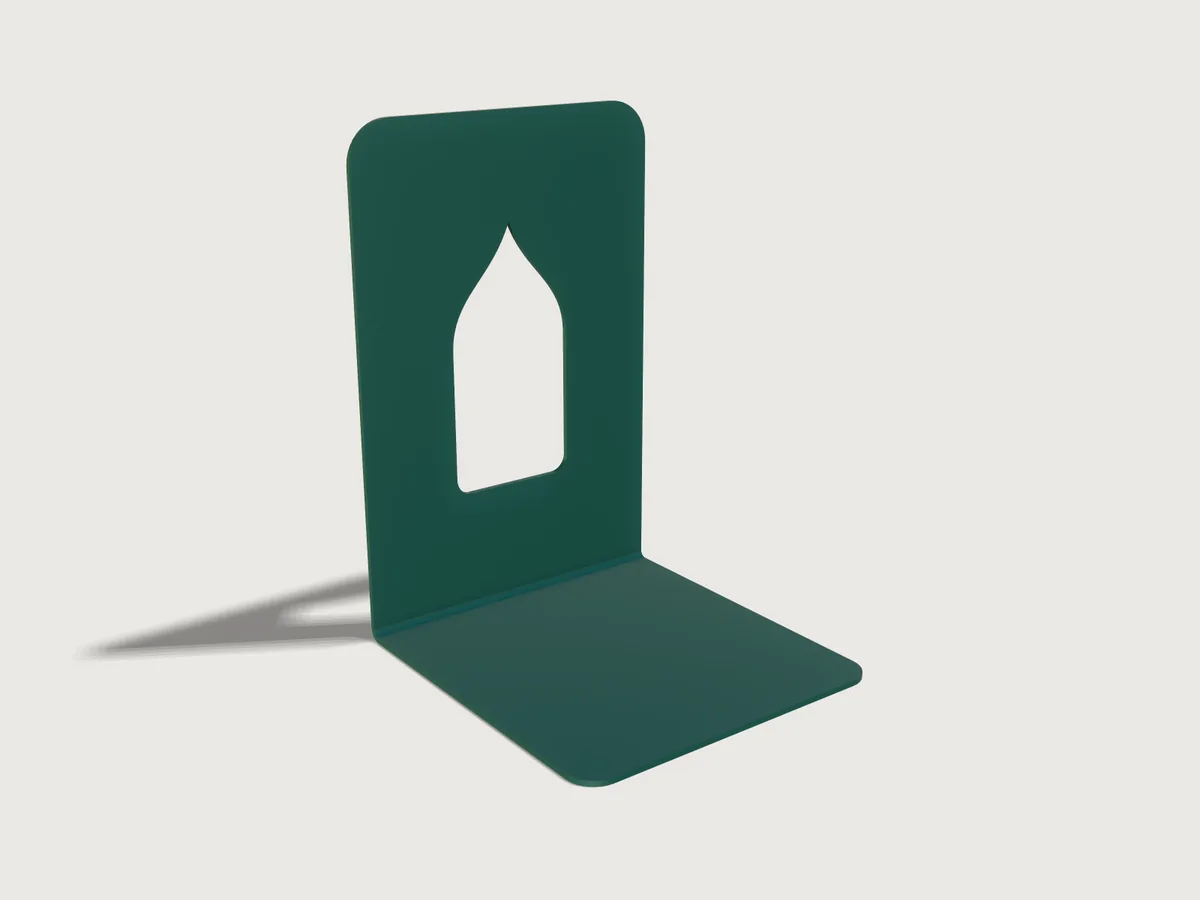
A bookend as a sheet-metal shop makes it: laser cut from one blank of 2 mm DC01 cold-rolled steel, bent once to 90° on a press brake and powder coated deep teal. An ogee-arch window lightens the upright, its two halves cubic splines; the corners are rounded. The bend's radius and K-factor come from the tooling and DIN 6935, the flat pattern is exported as DXF with its bend line, and the model proves its blank's area, its volume, its bend radius, the window's distance from the bend and that a press brake can bend it.
What it shows
- One sheet-metal part, one bend.
feature.sheetMetalmakes the foot the base (its sketch,Foot, drawn withsketch.path: three straight sides and two R10 front corners) and bends the upright up from its back edge by 90°, with the inner radius and K-factor given as formulas. - An outlined flange. The upright is a flange with
outline: its own sketch,Upright, drawn in the plane of the flat pattern beyond the foot's edge as if the bend had no width, with its R15 top corners and the window as a hole. The bend is laid out between the two at its bend allowance. - A spline cut-out. The window's straight sides and rounded sill are one
sketch.path; the arch is twosketch.splinecurves of degree 3 whose control points are formulas, so the arch keeps its shape when the bookend's size changes. The window is cut through the upright in the folded part and in the flat pattern alike. - The flat pattern.
sheetMetal.bendsgives the bend table (allowance, setback, deduction, blank size);file.exportwithsheetMetalwrites the flat pattern as DXF: the outline on the layeroutline, the bend line onbendUp. - Process checks as assertions.
bendRadius,holeToBend,flatAreaandbendable(the press-brake check with a punch and a die given as outlines), with a volume and the overall sizes (below). - Material and outputs.
material.presetgives steel's density; the finish is a satin powder coat, drawn as the dielectric layer it is (metallic0).variable.measurereports the mass. - Two public parameters.
variable.publishmakes Height and Width the knobs; every other size follows from them by formulas.
The real thing
- Material. DC01 (1.0330), cold-rolled low-carbon steel for cold forming to EN 10130: Rm 270 to 410 MPa, Re at most 280 MPa, elongation A80 at least 28 %. Thickness 2 mm, with the thickness and flatness tolerances of EN 10131.
- Bend. Air bent in an 88° V-die whose opening is 8 times the thickness, V = 16 mm, the usual choice for a radius about the thickness (6 to 12 t is the working range, 8 t the optimum: The Fabricator, Air forming and V-die selection). In air bending the die opening sets the radius: cold-rolled mild steel takes an inner radius of 15 to 17 % of V, 16 % as the working value (The Fabricator, How to predict an air-formed inside bend radius), so r = 0.16 × 16 = 2.56 mm. That is above the 0.5 to 1 t that cold-rolled steel needs (Fictiv, Sheet metal design guide), and the model asserts r ≥ t.
- K-factor. DIN 6935's correction factor k = 0.65 + 0.5 lg(r/s), valid for r/s < 5, puts the neutral fibre at k · s/2 from the inside, so the K-factor is k/2 = 0.3518 at r/s = 1.28. The bend allowance is π/2 · (r + K t) = 5.126 mm, the outside setback (r + t) = 4.56 mm, the bend deduction 3.994 mm.
- Sizes. Height is the overall height, from the shelf to the top of the upright (180 mm); the foot is height / √2 deep outside (127.28 mm), the depth of an ISO 216 page as tall as the upright, so a book of that height covers it. The blank is 120 × 303.29 mm.
- Window. An ogee arch, centred, of a fixed shape: twice as tall as it is wide, its arch 1.8 half-widths high, so it reads as an arch over the whole range. It is 0.4 × the width wide (48 mm) and 96 mm tall, unless the upright is too short for that: its height is at most 58 % of the upright's flat, and the width follows. Its middle is at 51 % of the upright's flat above the bend's tangent line, so the sill, with R6 corners, is 41.47 mm above that line (46.03 mm above the shelf) and the apex 142.03 mm above the shelf; the straight sides rise to the springing line, 43.2 mm below the apex. Each half of the arch is a cubic Bézier that leaves the side vertically and meets the other at the apex at 40.6° (2 atan(0.3 / 0.81), from its control points). In a low, wide bookend (120 × 200 mm) the window is limited by the height and stays small (33 × 67 mm); in a tall, narrow one (240 × 80 mm) it is 32 × 64 mm. Its least distance from the bend is 41.47 mm, against the rule of 2.5 t + r = 7.56 mm for a hole near a bend (Fictiv), so the bend does not distort it. No bend reliefs are needed: the bend runs across the blank's full width, so it has no end inside an edge.
- Making it. Cut the blank on a fibre laser from the DXF, the layer
outlineonly;bendUpis the bend line, for the brake operator (or a light etch). The kerf in 2 mm mild steel is a few tenths of a millimetre, and the machine's kerf compensation keeps the outline to size. The window narrows only at its apex, a point the laser cuts as a corner of its path. The arch's halves go out as DXFSPLINEentities, which current laser CAM reads; older software may need them converted to arcs or polylines first. Deburr, then bend once, the upright up, with an 88° punch with a standard R2 tip (at least 0.63 t, and no more than the 2.56 mm the die floats: Mate, Choosing the correct punch tip radius for air bending) in a V16 88° die with R2 shoulders. Nest the blank with the bend across the rolling direction where the sheet allows. Then degrease, phosphate and powder coat: RAL 6004 blue green, fine texture, satin. The window is where it hangs on the coating line, so it needs no hang hole. - Mass. 511.98 g (volume 65 221 mm³ of steel at 7850 kg/m³).
- Simplified, or left out.
- The powder coat's thickness and the slightly rounded edges it leaves are not modelled; nor is the springback the operator over-bends for.
- Self-adhesive felt or rubber pads under the foot, which keep it from scratching a shelf, are an accessory, not modelled.
Parameters
| Parameter | Range | Default | What it does |
|---|---|---|---|
| Height | 120 to 240 mm, step 10 | 180 mm | overall height; the foot is height / √2 deep and the window follows within its limit |
| Width | 80 to 200 mm, step 10 | 120 mm | width of the upright and the foot; the window is 0.4 × the width wide, within its limit |
Checks
- Overall height. The top of the upright is at Height above the shelf (179.999999 mm measured).
- Foot depth. The part is height / √2 deep, outside: 127.2792 mm.
- Flat pattern area in closed form. The blank's area, as the flat pattern lays it out, must equal the width times the flat length (foot flat + bend allowance + upright flat), less the four rounded corners ((1 − π/4) r² each), less the window: its rectangle less two rounded corners, plus the two Bézier halves of the arch (the area under a cubic Bézier, ∫ x dy, in closed form from its four control points), exact to 0.01 mm². At the defaults: 32 554.4081 mm².
- Folded volume from the flat pattern. The folded part's volume must be the flat area times the thickness, plus π/2 · width · t² · (½ − K), the extra a bend holds when its neutral fibre is not in the middle: 65 220.5544 mm³, to 0.01 mm³.
- Bend radius for cold-rolled steel. The inner bend radius is at least the thickness: 2.56 mm.
- Window clear of the bend. The window is at least 2.5 t + r = 7.56 mm from the bend's tangent line: 41.47 mm.
- Bendable on a press brake. With an 88° punch of R2 tip, its flanks 30 mm high on a body 100 mm high, and an 88° V16 die with R2 shoulders, the bend is proven to clear both tools over its whole stroke.
craft3d-cli check-range proves all seven at 37 points: the defaults, the four corners of the ranges
and 32 random points (a run with 400 random points passed too). The flat pattern's length is proven
through its area, not on its own (Platform notes).
The README in the model's repository has the rest (Files, Rebuild, Difficulty, Platform notes, Licence): the whole README on GitHub.