
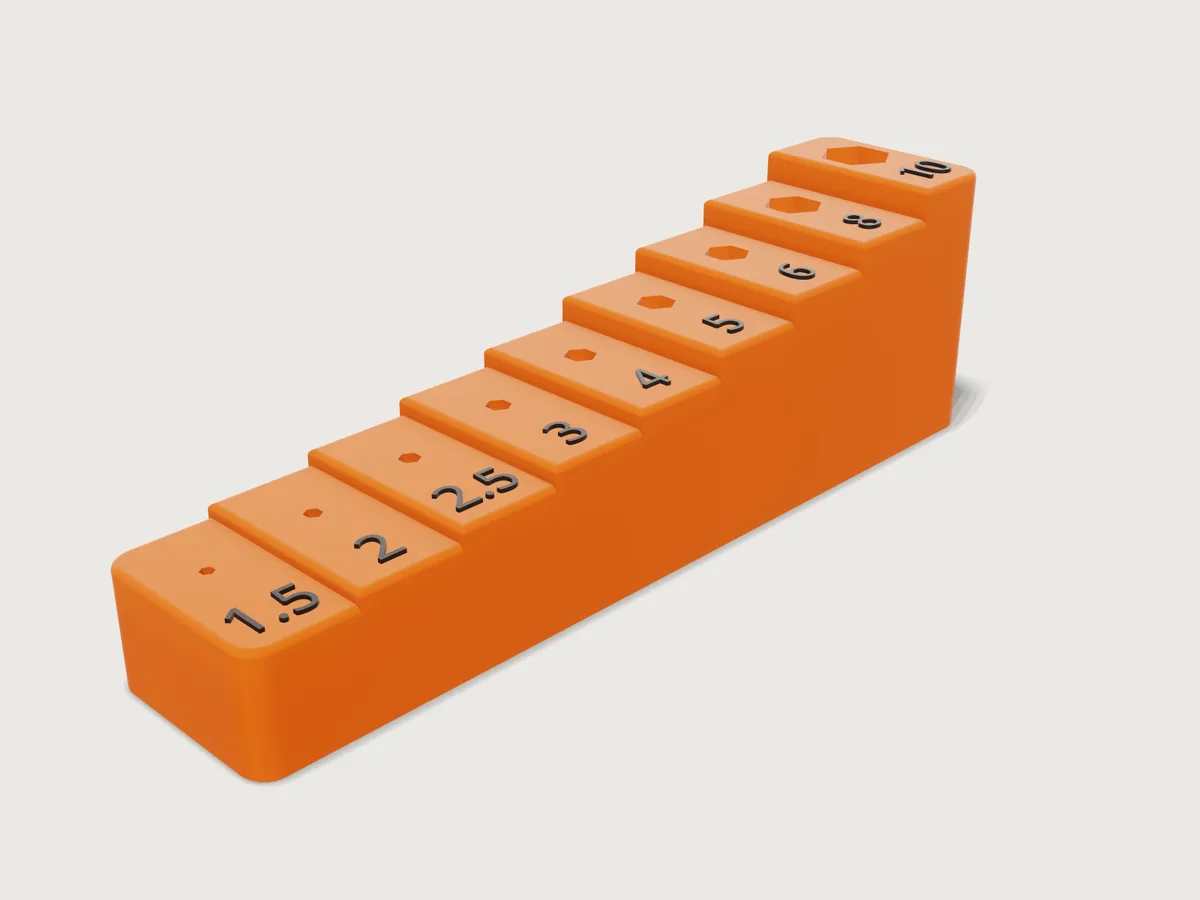
A desk stand for a metric hex key set, 1.5 to 10 mm, printed in PLA without supports. Nine steps rise with the keys' lengths, each with a hexagonal socket sized from ISO 2936 plus a print clearance, and each size embossed in front of its socket in a second colour. A table of the standard drives every socket, the heights of the steps and the labels; the stand proves its walls, its overhangs and its sockets itself.
What it shows
- A table of a standard drives the model.
table.setholds the nine keys of ISO 2936 with their width across flats (the table's key) and the length of their long arm. Every socket, every step height and every label readshex_keys[k]. - Positions and depths from formulas. One
sketch.polylinedraws the side profile of the nine steps; step k isfloor_thickness + insertion_share * hex_keys[k].long_armhigh, andfeature.extrudeturns it into the block. All nine sockets are cut from one sketch on the floor plane (feature.extrudewiththroughAllandcut), so each socket ends at the floor and its depth is its key's share of the long arm, whatever Insertion is set to. - Hexagons from formulas. Each socket is a
sketch.polylinehexagon whose corners are(hex_keys[k].across_flats + 2 * clearance) / sqrt(3)from its centre, so the clearance follows the Clearance parameter. - Text from formulas.
sketch.textwrites{hex_keys[k].across_flats}, so the labels read the table. Each label sits on its own step (sketch.createon a plane at the step's height) and is extrudedlabel_reliefhigh; the nine are joined into one body,Size labels. - Fillets and chamfers.
feature.filletrounds the four vertical corners (4 mm) and the top rims of every step (1 mm);feature.chamferwithchainputs a 0.4 mm first-layer chamfer round the whole bottom edge in one pair of faces. - Print checks as assertions.
measure.thicknesson the sockets' walls and floors,measure.draftagainst the build direction on every face but the one on the bed, a section in closed form and a count (below).variable.measurereports the volume and the mass. - Material and export.
material.preset(abs, recoloured orange and matte, black for the labels) withbody.materialfor PLA's density;file.exportwrites a 3MF with both bodies in their colours, in the print orientation.
The real thing
-
Standard. Dimensions according to ISO 2936:2014, hexagon socket screw keys, the normal series. The model's table holds the nominal width across flats s (the key's largest; a key is never over it) and the length of the long arm l1:
s 1.5 2 2.5 3 4 5 6 8 10 long arm l1 46.5 52 58.5 66 74 85 96 108 122 socket across flats (clearance 0.15) 1.8 2.3 2.8 3.3 4.3 5.3 6.3 8.3 10.3 socket depth (insertion 0.35) 16.28 18.2 20.48 23.1 25.9 29.75 33.6 37.8 42.7 -
Use. Each key stands in its socket on its long arm; the short arm is the handle on top, and the tops climb from 48.5 mm to 124 mm above the desk, so every key can be read and taken. Turn each key so its short arm points to the left, over the shorter keys (the six flats always give it a place within 30° of that). Each arm then passes above every key it reaches: the 10 mm key's arm, about 119 mm up, over the 8 mm key's top at 110 mm, and so on down to the 2 mm key's at 53 mm over the 1.5 mm key's top at 48.5 mm. Pointed to the back instead, a full set (about 257 g of keys, on a stand printed at 15 % infill, about 70 g: estimates, not measured by the model) puts its centre of gravity about 24 mm back on the 32 mm deep stand and 60 mm up, and the stand tips at about 7°; to the left the weight stays over the middle of the footprint.
-
Size. 144 × 32 mm on the desk, 44.7 mm high at the 10 mm step (45.3 mm with its label). Steps are 16 mm wide; the sockets stand on one line 20 mm from the front, the labels 6.5 mm from it, 6 mm high.
-
Printing. FDM, PLA, as modelled: flat on the bed, the sockets upright. Nothing overhangs: every wall is vertical, every other face looks up, and the 0.4 mm × 45° first-layer chamfer round the bottom takes up the elephant's foot of the first layer. The floors under the sockets are 2 mm, the thinnest found; the side walls are 2.85 mm or more at the defaults (beside the 10 mm socket), less only within the 1 mm rounded rims; the proof's bound is at least 1.4 mm everywhere. The labels are a body of their own: on a printer with two filaments, give the stand orange and the labels black (
exports/hex-key-stand.3mfcarries both bodies in their colours, as two separate objects; how to make them one object of two parts depends on the slicer: in PrusaSlicer and OrcaSlicer select both and choose Assemble); on a single filament, print both in one colour. 0.2 mm layers, 3 walls and 15 % infill suit the stand. The figures are Noto Sans Regular, the only outline font 3DCraft bundles, 6 mm high: their strokes are about 0.75 mm wide and the dots 0.9 mm, one to two lines of a 0.4 mm nozzle, so print the labels with 2 walls and no infill. -
Clearance. 0.15 mm per side is a sliding fit on a well-tuned printer; holes print undersize on many printers, the small ones most, so raise Clearance if the 1.5 and 2 mm keys stick.
-
Mass. The model as a solid weighs 157.0 g in PLA (stand 126 545 mm³, labels 64 mm³); a print with infill weighs less.
-
Simplified, or left out.
- The socket mouths have no lead-in chamfer and the short vertical edges where a step rises from the one before are sharp: 3DCraft refuses both (Platform notes).
- The table's sizes are the keys' nominal s; the slightly smaller s min and the corner rounding of a real key are left to the clearance.
Parameters
| Parameter | Range | Default | What it does |
|---|---|---|---|
| Clearance | 0.1 to 0.4 mm, step 0.05 | 0.15 mm | gap per side between a key's flats and its socket |
| Label relief | 0.4 to 1.2 mm, step 0.2 | 0.6 mm | how far the sizes stand proud of the steps |
| Insertion | 0.25 to 0.45, step 0.05 | 0.35 | share of each long arm in the stand: socket depths and step heights |
Checks
- Nine key sockets. The sockets' floors are counted: there are
key_count(9). - Socket walls and floors at least 1.2 mm.
measure.thicknessfrom every socket face: 2 mm found (the floors), at least 1.4 mm proven (the side walls are thicker, 2.85 mm or more at the defaults). - No overhang below 45 degrees.
measure.draftalong +z on every face of the stand but the bottom: the least is −45°, the first-layer chamfer. The labels stand on the steps, so their undersides are not overhangs. The check is not proven: on the four vertical corner rounds, which the chamfer trims,measure.draftfinds 0° but bounds them only at −47.1°, and the chamfer sits exactly at the limit, so no slack is left for that bound (F-102). - Socket section in closed form. The stand cut halfway up its lowest step must be the footprint, less its four rounded corners, less the nine hexagons: 144 × 32 − (4 − π) 4² − (√3/2) Σ (s + 2 c)² = 4344.408 mm². It proves each socket's size and clearance.
- Top step seats the 10 mm key. The stand's top is
floor_thickness + insertion_share * l1of the 10 mm key: 44.7 mm.
craft3d-cli check-range passes four and finds the overhang check holding (not proven, as above) at the defaults, the corners of the three ranges and eight
random points.
The README in the model's repository has the rest (Files, Rebuild, Difficulty, Platform notes, Licence): the whole README on GitHub.