
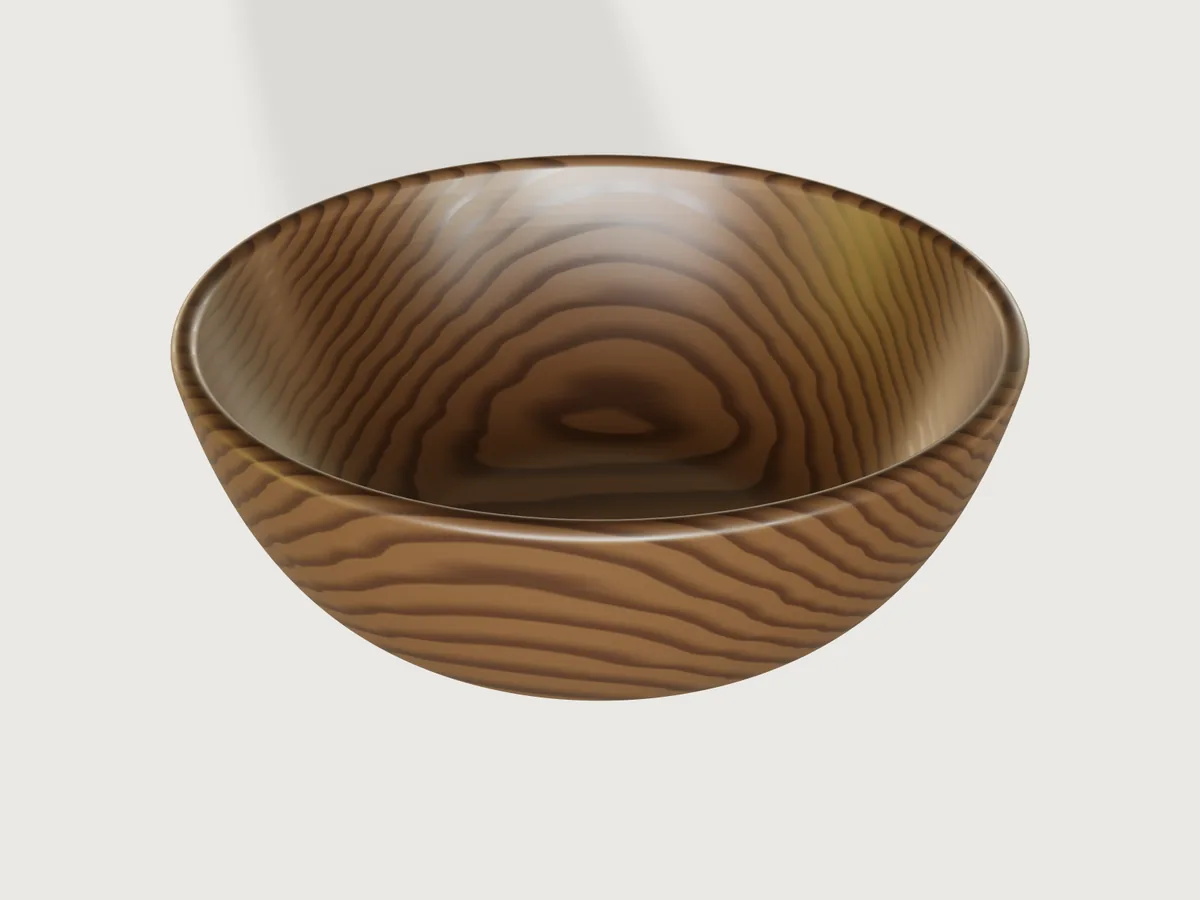
A serving bowl as a woodturner makes it: Ø 220 × 85 mm, turned from a 10 × 4 inch walnut blank, with an even 7 mm wall from a fully rounded rim down to a foot ring. One revolved half section makes the whole bowl: a spline shaped by constraints for the outside, the exact offset of that spline for the inside, so the wall is even everywhere. The bowl works out its own capacity (1.84 litres brimful) and proves its wall with Steiner's formula for parallel surfaces.
What it shows
- A spline shaped by constraints. The outside of the bowl is one cubic spline (
sketch.spline) from the flat of the base to the rim. Its first handle is held at a radius and made tangent to the base (sketch.constraintangent), which sets its height; its second handle is held at a height and made tangent to the rim's bead, which sets its radius. The base runs into the wall without a crease, and the wall into the rim. - An even wall from a formula curve. The inside is the true offset of that spline, 7 mm square to it
at every point:
sketch.curvewith the spline's own Bézier formula less the wall thickness times its unit normal. It follows the three parameters as the spline does. - A full round rim.
sketch.arc: a half circle of the wall's thickness across the end of the wall, tangent to both faces. The wall flares out 12° at the rim. - One revolve. The closed half section (inside, outside, rim, the foot ring and the recess inside it)
turns into the bowl in one
feature.revolve. - Fillets on the foot.
feature.filletrounds the outer bottom edge of the foot ring (2 mm) and coves the corner where it meets the base (3 mm). The chuck recess inside the ring is left as a turner cuts it: a 10° dovetail wall and sharp corners. The last fillet names the body, so it is called Bowl. - Material.
material.presetwalnutwith its solid texture placed as in a face-grain blank (the pith above the bowl, the rings 4.5 mm apart), cooled to oiled walnut's chocolate brown and given a thin satin coat; its density, 640 kg/m³, gives the mass. - Outputs.
variable.measuregives the volume of wood, the volume of the foot ring, the areas of the outer and inner wall and the mass;variable.outputthe capacity in millilitres and the blank in whole inches. - Checks.
assert.addwith closed forms, bounds and the measured size (below). - A turning template.
file.exportwrites the half section at 1:1 as SVG.
The real thing
- Size. Ø 220 × 85 mm, a small serving bowl: 1.84 L brimful, about 1.3 L in use, a side salad for two to four. No standard governs a bowl; the proportions are those of a common salad bowl: the foot ring 0.36 of the rim's diameter (Ø 79.2 mm; never less than the recess plus 8 mm of ring at its floor), the flat of the base 0.04 of the diameter wider than the foot on each side (Ø 96.8 mm), both handles of the curve at 0.55 of the run (the lower one 0.55 of the way out from the base's edge to where the wall meets the rim's bead, the upper one 0.55 of the wall's rise below that point, on the line of the flare).
- Blank. Walnut bowl blanks are sold in whole inches. The model adds a turning allowance of 6 mm on every face (for truing up a blank that is out of round and checked at the ends) and rounds up to the inch: 10 × 4 in (254 × 101.6 mm) at the default size (the outputs Blank diameter and Blank thickness). Face grain: the blank is cut from a plank with the grain running across the bowl and the pith above it, left out, so the rings show as nested ovals in the bottom (the eye) and sweep up the walls.
- Wall. 7 mm, even from rim to bottom, the bottom as thick as the sides; a utility bowl's wall that stands washing and wetting. The rim is rounded over its full thickness; the foot ring is 6 mm high, rounded at its outer bottom edge and coved into the base.
- Turning it.
- Rough turn: mount the blank on a faceplate or screw chuck on its top face, true it up and shape the outside with a bowl gouge, held against the template. Cut the foot ring and the recess inside it: Ø 56 mm at the mouth, 6 mm deep, its wall dovetailed 10° (Ø 58.1 mm at the floor) with sharp corners, a fixed size for the common 50 mm dovetail jaws in expansion (check your jaws' range); it stays the same at every diameter, and the foot grows round it.
- Reverse it into the chuck, face the top and hollow the inside to an even 7 mm, checking the wall with double-ended callipers; round over the rim.
- Sand to 320 grit with the lathe running, then across the grain with it stopped, and oil it. Turned from wet wood, the bowl is first rough turned with a wall of about a tenth of its diameter, left to dry and then turned to size.
- Finish. A food-safe drying oil, several thin coats, drawn as a satin layer over the wood.
- Mass. 290.4 g of walnut, 453 735 mm³ of wood; it holds 1839.7 mL brimful.
- Simplified, or left out.
- The wood is drawn by a solid texture, not a scan of a board, and it neither moves nor checks.
Parameters
| Parameter | Range | Default |
|---|---|---|
| Diameter | 160 to 300 mm, in 5 mm | 220 mm |
| Height | 55 to 120 mm, in 5 mm | 85 mm |
| Wall thickness | 5 to 10 mm, in 0.5 mm | 7 mm |
The foot ring, the base, the curve's handles and the blank follow from them; the rim bead's radius is half the wall, and the recess is fixed.
Checks
- Foot ring in closed form. The wood below the base (
volumeBelowthe plane at the foot's height) must equal the ring round the dovetailed recess, π (R² h − a² h − a k h² − k² h³/3) with a the recess's radius at its mouth and k = tan 10°, less the rounded edge and plus the cove (Pappus, each (1 − π/4) r² turned at its centroid, (10 − 3π)/(12 − 3π) r from the corner). 14 493.177 mm³ at the default, exact to 0.01 mm³. - Even wall by Steiner's formula. A wall made by moving every point of a surface a distance t along its normal has the volume t (Aout + Ain) / 2 − t³/6 ∫K dA (Steiner's formula for parallel surfaces), and ∫K dA over the outside is 2π (1 − sin 12°), because its normals turn from straight down to 12° below the horizontal at the rim (Gauss–Bonnet). The flat of the base adds its area to both sides, and the bead adds a half disc turned about the axis (Pappus). The wood above the foot must equal that sum, with Aout and Ain the measured areas of the outer and inner wall, within the inner curve's fitting tolerance: half the document's tolerance over the inner wall, 24.9 mm³ at the default. It matches to 0.03 mm³ (439 241.585 mm³ against 439 241.553 mm³). An inner wall 1 µm off the true offset on average misses it by about 50 mm³ and fails.
- Capacity between its cone and its cylinder. The brimful capacity (the solid of revolution under the outer profile and the rim's top, in closed form from the spline's control points and the bead's arc, less the wood above the foot) must lie between the cone from the inside of the base to the inside of the rim (with the column above it) and the cylinder of the bead's centre radius over the inside depth: 1394 to 2566 mL at the default; it is 1839.7 mL. The inside is convex, so the cone lies inside it.
- Diameter as drawn and Height as drawn. The measured extents (219.993 mm and 84.998 mm, measured on a fine mesh) are the bowl's diameter and height within 0.01 mm, so the blank worked out from them holds the bowl with its allowance.
craft3d-cli check-range proves all five at 17 points: the defaults, the eight corners of the ranges and
eight random points.
The wall's thickness is not asserted with measure.thickness, as the catalogue asked: on this wall it
takes 5.6 s and proves nothing (at least 0 mm) while it finds 7.000 mm. measure.distance between the
outer and the inner wall finds 7.000 mm but proves only 6.23 mm. Steiner's formula is the proof used.
The README in the model's repository has the rest (Files, Rebuild, Difficulty, Platform notes, Licence): the whole README on GitHub.