
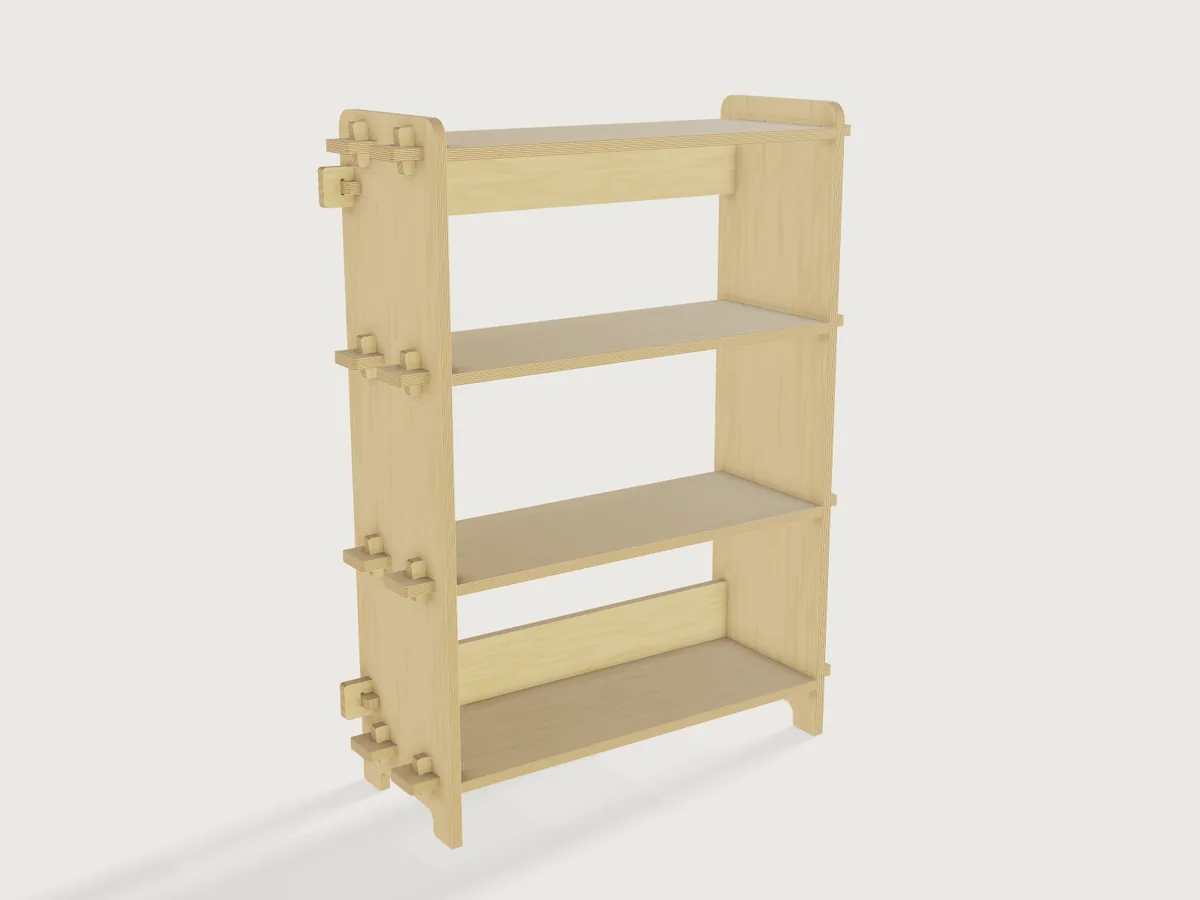
An open bookcase of 18 mm birch plywood, 750 wide, 1100 high and 300 mm deep, routed on a CNC router from
one 2500 × 1250 mm sheet and put together by hand without screws, glue or tools. Each shelf ends in two
tenons that pass through the sides and are locked by tapered wedges, tusk tenons as on a trestle table; two
back rails, tenoned and wedged the same way, keep it square. Every part is one sketch with its mortises and
the cutter's reliefs drawn in as holes, every part is a plate that cut.list lists, and the mortises follow
the sheet's measured thickness. The model proves its joints, its parts, its fit on the sheet and its shelves'
sag, and exports the router's sheet as DXF.
What it shows
-
One sketch per part. Each part is one
sketch.pathof lines and arcs given by their centres, every point a formula of the variables, with its mortises as further closed paths inside the outline: holes in the sketch, extruded once (feature.extrude), never cut afterwards. The side's shelf mortises are one mortise in a 2 ×shelf_countgrid (sketch.patternwithcount2), the rail mortises a pair; a shelf's wedge mortises are a right-hand and a left-hand mortise, each repeated front to back. -
Reliefs for a round cutter. A router cutter cannot cut a sharp inside corner, so every inside corner gets a relief of the cutter's radius plus 0.1 mm: a dogbone (a half circle through the corner, on the diagonal) at the four corners of every mortise in the sides and at the near end of every wedge mortise; a T-bone (a half circle cut along the long wall) at the far end of every wedge mortise, so that the wall the wedge bears on stays straight across its whole width; and a T-bone (a half circle into the tenon) at the root of every tenon, where it is hidden inside the side and the shoulder still seats flat against the side. Their radius follows the Cutter diameter parameter.
-
Every part a plate. Side, shelf, back rail and wedge are each extruded once; the copies are separate bodies, made by
feature.transform(shelves, rails, wedges) andfeature.mirror(the right side, the right-hand wedges), so thatcut.listsees each as a plate (afeature.patternof separate plates is one body that is not a plate, see Platform notes). The fourth and fifth shelves and their wedges are conditional features (when), so the shelf count adds and removes whole parts. -
Cut list and router file.
cut.listlists 28 parts at the defaults, four distinct ones:Part Count Length × width Holes Side 2 1100 × 300 mm 10 Shelf 4 850 × 280 mm 4 Back rail 2 850 × 110 mm 2 Wedge 20 65.6 × 24.5 mm 0 cut.exportwrites them all, at true size and each on a layer of its own, in rows on one 2500 mm long sheet: the router's DXF. -
Interference.
document.interferencechecks all 378 pairs of the 28 bodies: 54 touch (every shoulder on a side, every tenon on the floor of its mortise, every wedge on a side's face and on the far end of its mortise, the rails against the top and bottom shelves), none overlap and none is unknown. The same check runs at every load as anoverlapassertion;measure.clearancekeeps the rails' wedges clear of the shelves' wedges. -
A range that follows another parameter. The width's upper end is a formula of the measured sheet thickness: the widest width, in 10 mm steps, whose shelves still meet the sag limit (Shelf sag below).
-
Materials.
body.appearancedraws the plies of the panel's edges as a wood pattern whose pith lies 100 m away, so its rings are flat layers parallel to the faces, dark and light bands for the alternating face-grain and cross plies (a real panel has a glue line between every pair of plies);face.appearancegives the two faces of each part the plain, softly waved figure of rotary-cut birch veneer, its pith 5 to 20 m away;body.materialgives birch plywood's density. -
Outputs.
variable.measuremeasures the clear span between the sides, the plywood's volume, the mass, the centre of mass and the parts' lengths on the sheet;variable.outputworks out the shelf's sag, the tipping angle, the potential energy, the wedge's reserve of drive and the sheet layout from them.
The real thing
-
Plywood. Finnish or Baltic birch plywood, 18 mm nominal, 13 plies of 1.45 mm birch veneer, the phenolic bond of EN 314-2 class 3 (the dark glue lines of the edges), face grades S/BB (EN 635 classes II and III, the S face outward), sheet 2500 × 1250 mm with the face grain along the 2500 mm side. Sources: the Handbook of Finnish Plywood (Finnish Forest Industries Federation, 2002: §1.2 bond, Table 2-1 grades "B=I, S=II, BB=III and WG=IV", Table 2-4 sizes, "the grain of the face veneer runs parallel to the first dimension stated"), and the Riga Ply datasheet (Latvijas Finieris, 2022: 18 mm, 13 plies, 1.45 mm veneers).
-
Thickness. A sheet sold as 18 mm is not 18 mm. The Handbook (Table 2-3) gives EN 315's limits for 18 mm sanded birch plywood as 17.1 to 18.7 mm, and the Finnish mills' own as 17.1 to 18.1 mm; its design tables use a mean of 17.6 mm (Table 3-2). That is the default here, and the Measured sheet thickness parameter spans EN 315's limits. Measure the sheet with calipers in several places and enter the largest: every part is that thick, and every mortise is that plus a fit clearance of 0.4 mm (0.2 mm a side), a slip fit for hand assembly.
-
Cutter. A ¼ in (6.35 mm) two-flute solid-carbide compression spiral, such as Amana Tool 46170 (cutting length ⅞ in, 22.2 mm, the bottom 7 mm cutting upward and the rest downward, overall length 2½ in; ToolsToday), which leaves both faces of the veneer clean and cuts the sheet's full thickness, less than three times its diameter. The reliefs are 3.275 mm in radius.
-
Making it.
- Load
exports/flat-pack-bookcase-sheet.dxfinto the CAM program and set the parts 10 mm in from the sheet's edges; the drawing is the parts at true size, so the program puts the cutter outside the outlines and inside the holes. The reliefs are drawn: the cutter plunges into each one as it goes round the corner. - Feeds and passes: about 18 000 rpm and 3 m/min, in two passes, the first about 9 mm deep, past the bit's 7 mm up-cut tip so that the down-cut flutes shear the top veneer, the second through. Amana's chart for its ¼ in two-flute compression spirals in Baltic birch (PDF) gives, at 18 000 rpm, 150 to 180 in/min (0.004 to 0.005 in, 0.10 to 0.13 mm, per tooth) one diameter deep and 25 % less two diameters deep; they are starting values, to be tuned on the machine.
- Order: the holes before the outlines, and the small parts first. The wedges, 65.6 × 24.5 mm, move under vacuum: leave them an onion skin (a few tenths of a millimetre at the bottom of the last pass, cut free with a knife) or tabs.
- Edge finish: round over the exposed edges 2 to 3 mm with a round-over bit or by hand (the sides' front,
top and feet, the shelves' front edges and the wedges' heads); keep crisp what must bear (the shoulders,
the mortise walls and the wedges' straight and sloped edges); ease the tenons' ends by about 1 mm. Oil
everything, with a second coat on the plywood's edges, whose cross plies take it up. The model shows
every edge sharp, as the router leaves it:
cut.listrefuses a plate with broken edges (F-086).
- Load
-
The joint. Each shelf has two tenons at each end, 70 mm wide, 35 mm in from its front and back edges, that pass through the side and stand 50 mm proud of it. In each tenon a wedge mortise runs from 2 mm inside the side's outer face to 22 mm outside it, and the tenon goes on 28 mm beyond it. The wedge, cut from the same sheet, tapers 1 in 8: driven through the mortise, it bears on the side's face with its straight edge and on the far end of the mortise with its slope, across the whole 17.6 mm of its thickness (the far wall is straight for 18.0 mm), so it pushes the tenon out and pulls the shelf's shoulder hard against the inside of the side. Because the mortise starts 2 mm inside the side, the wedge never reaches its near end: 2 mm of draw are in reserve, and with the 1 in 8 taper the wedge can be driven 16 mm further if the joint ever works loose. It stands 26 mm proud of the tenon to be struck and 22 mm past it to be knocked out. A rail's wedge lies along the side 5 mm short of its back edge, so at its full 16 mm of further drive it would stand 11 mm past the back edge, against the wall.
-
Putting it together. Every tenon points the same way, across the bookcase, so the second side goes on all of them at once.
- Lay one side flat on two battens, outer face down, high enough for the tenons to pass through.
- Stand the four shelves and the two back rails in its mortises; they rest on their shoulders.
- Lower the other side onto their upper tenons, all ten at once, and tap it down evenly until every shoulder seats.
- Drive that side's eight shelf wedges first, then put in and drive its two rail wedges, from the front towards the back.
- Stand the case up on its feet and drive the first side's wedges the same way: the shelves' wedges downward from above, then the rails'.
The shelf wedges go in before the rail wedges because the lower rail's wedge starts 10.6 mm behind the bottom shelf's back wedge, 20.2 mm above its head, where a wide mallet would hit it; to tighten that shelf wedge later, knock the rail's wedge out first, or use a drift.
-
Racking. The shelves alone would let the case lean sideways: their tenons are only a sheet thick in the plane of the racking. The two back rails, 110 mm high, under the top shelf and on the bottom shelf, are each wedged with their shoulders, 25 mm above and 25 mm below their 60 mm tenon, tight against both sides, which keeps the corners square. (This is not computed.)
-
Standing. Each side ends in two feet, 60 mm long, with a 40 mm high arch between them, so the case stands on four short feet rather than on two full-length edges that rock on any bump in between. On a floor whose four contact points are out of plane it still rocks, as anything on four feet does; a felt pad under the short foot settles it.
-
Fix it to the wall. Empty, the bookcase tips forward over its front feet when tilted 14.9°, or when pulled forward at the top with 27.3 N (its 20.18 kg act 156.5 mm behind the front edge, 569.7 mm up). Screw an anti-tip strap to the top back rail and to the wall, as for any bookcase this tall. EN 14749:2016 sets stability requirements (§5.4) for storage furniture; the US CPSC's review of it (Federal Register 2022-24587, §V.D) gives its scope as furniture "with a height >=600 mm" and "a potential energy … exceeding 60 N-m". This case, empty, has 112.8 N·m; its tests (EN 16122) are not attempted here.
-
Shelf sag. The Sagulator (woodbin.com) says "A fully loaded bookshelf weighs 20-40 pounds (9-18 kg) per running foot". The shelf is designed for the middle of that, 30 lb per running foot (44.65 kg/m), simply supported across the clear span of 714.8 mm (the wedged tenons' end fixity ignored), with birch plywood's mean bending modulus along the face grain, 10 048 N/mm² for 18 mm, 13-ply panels (Handbook, Table 3-2). It sags 1.164 mm, within the Sagulator's target of "0.02″ per foot or less" (span/600, 1.191 mm). The Sagulator derives that target from the sag the eye notices, "1/32″ (0.03″) per running foot", and from wood shelves sagging "an additional 50% over time": after creep the shelf sags 1.746 mm, still under the 1.861 mm (span/384) that would show. The limit decides the widest bookcase: 730 mm on a 17.1 mm sheet, 750 mm on 17.6 mm, 800 mm on 18.7 mm.
-
Weight and sheet. 1.686 m² of plywood, 54.0 % of the sheet, 20.18 kg at the Handbook's mean density of 680 kg/m³ (Table 3-1).
Parameters
| Parameter | Range | Default |
|---|---|---|
| Width (over the sides) | 600 mm to the widest that meets the sag limit for the sheet (730 to 800 mm), in 10 mm steps; a thinner sheet lowers the maximum, so set the sheet and the width together (or let the width be clamped) | 750 mm |
| Shelves (top and bottom included) | 3 to 5 | 4 |
| Measured sheet thickness | 17.1 to 18.7 mm, in 0.05 mm steps | 17.6 mm |
| Cutter diameter | 5 to 8 mm, in 0.05 mm steps | 6.35 mm |
The height (1100 mm), depth (300 mm, shelves 280 mm) and the joint's proportions are fixed. Over the tenons the bookcase is 100 mm wider than over the sides (850 mm at the default width). The shelves are spaced evenly between the bottom one, 90 mm above the floor, and the top one, 40 mm below the top: 458.6 mm clear between shelves with three shelves, 299.9 mm with four and 220.5 mm with five (room for paperbacks, not for a 240 mm hardcover).
Checks
At the defaults (26 assertions, all passed):
- Every part is a plate of the measured sheet. 56 faces, two for each of the 28 parts, are a measured 17.6 mm from the face opposite them.
- Each part in closed form. The volume of the side (5 456 124.12 mm³), the shelf (3 818 560.30 mm³), the back rail (1 508 070.55 mm³) and the wedge (23 937.63 mm³) equals the sheet thickness times its area worked out by hand: the outline less its rounded corners, the feet's arch, the T-bones (π r² / 2 each), the mortises with their dogbones (r² (π/2 − 1) each), and, for the wedge, a trapezoid less four corners rounded at 90°, 90° and 90° ± atan(1/8), R² (cot(θ/2) − (π − θ)/2) each. A missing relief or a mortise of the wrong size fails it.
- Every mortise is the sheet plus the clearance. The shelf and rail mortises in the side, and the wedge mortises in a shelf and a rail, measure 18.0 mm across (17.6 + 0.4); a shelf's tenon, resting on the floor of its mortise, clears its top by 0.4 mm.
- Every inside corner relieved for the cutter. 200 cylindrical faces of the relief's radius: four reliefs in each mortise of the sides, shelves and rails, and a T-bone at each side of every tenon's root. The relief's radius (3.275 mm) is at least the cutter's (3.175 mm), and the sheet (17.6 mm) is no deeper than four cutter diameters (25.4 mm).
- The wedge draws. The wedge touches the side's face (0 mm) and the far end of its mortise (0 mm), and stands 2 mm off the near end, which lies inside the side. The far end is straight across its whole width: its face is 316.8 mm², 18.0 × 17.6 mm.
- Wedges clear of each other. The rails' wedges are at least 22.8 mm from the shelves' wedges, and start 10.6 mm behind the bottom shelf's back wedge.
- Shelf sag within span/600: 1.164 mm against 1.191 mm.
- No two parts overlap, and the bookcase stands on four feet (four faces at floor level).
- The parts fit one sheet. Laid with the grain along the sheet, the two sides end to end take
2236 mm of the 2500 mm; the shelves follow two by two, the rails side by side in one place, and with the
sides' row that takes 1200 mm of the 1250 mm width; the end of one row of shelves holds 63 wedges, of
20 needed; and the plywood's area, 1 686 442 mm², is less than the sheet's.
cut.export's own layout, a plain row after row in the cut list's order, also fits the sheet at the defaults (2488 × 1042.5 mm), but not at five shelves (1300.8 mm high): there the CAM program nests the parts, as the layout knows no sheet height (F-162).
craft3d-cli check-range proves all 26 at 25 points: the defaults, all 16 corners of the four parameters'
ranges (the width moved into its range where a thin sheet narrows it) and 8 random points.
The README in the model's repository has the rest (Files, Rebuild, Difficulty, Platform notes, Licence): the whole README on GitHub.