
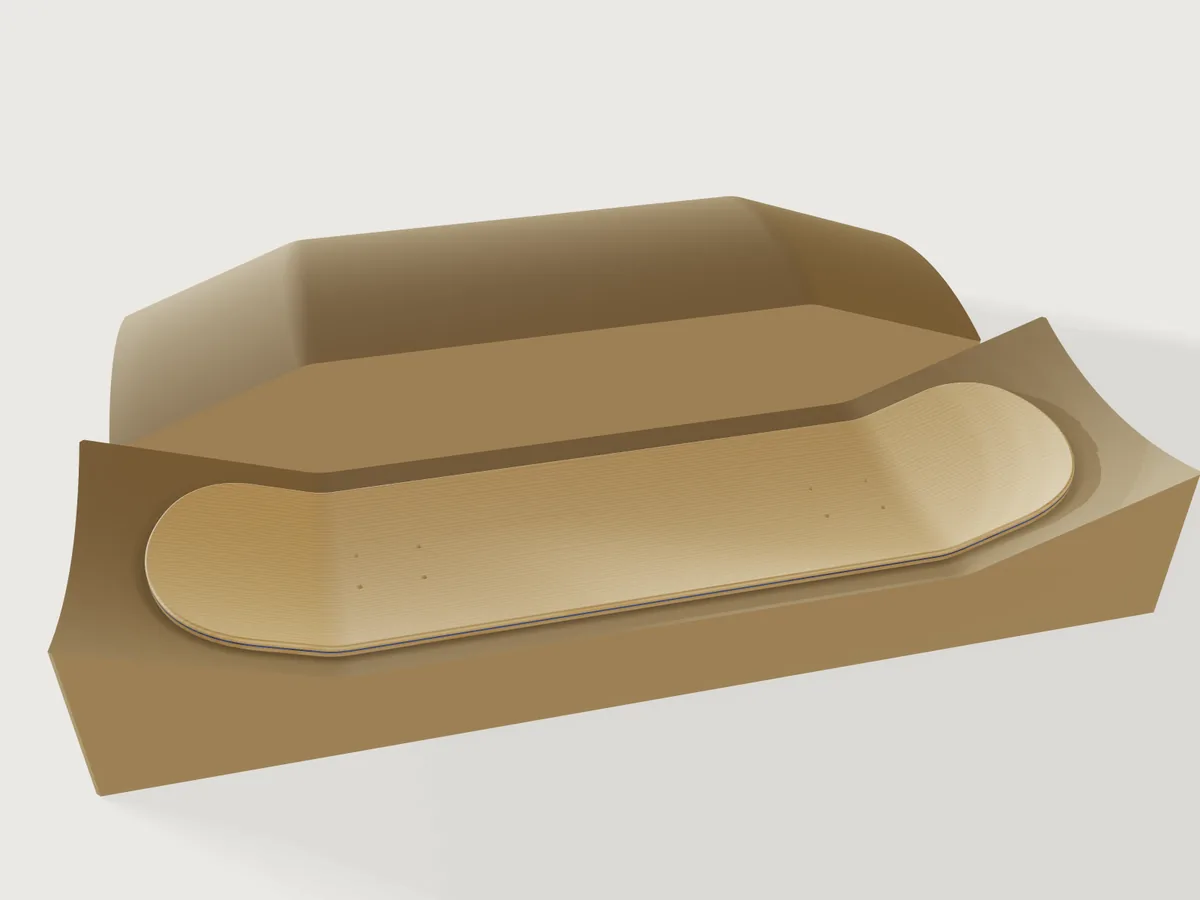
An original street deck, 8.0 × 31.75 in with a 14.25 in wheelbase, laid up as the trade does it from seven 1/16 in hard-maple veneers with a dyed centre core. The deck has a radial concave and 20° kicks. It is pressed in a two-part MDF mould, then cut to shape, drilled for the trucks and rounded at the rails. The model shows the finished deck back in the lower mould half, where it was pressed, with the upper half turned face up beside it. Its checks prove the layup, the gap the closed mould leaves, the truck pattern and the kick, and they check the concave and the veneer's curvature in the bends against closed forms.
What it shows
- Inches.
build.jsonstarts withdocument.setUnit(inches, numbers kept), so it builds the same deck in a document opened in millimetres. - A deck top made of swept arcs. One
sketch.pathdraws the deck top's centre line in the zx plane: tail kick, a 3 in bend, the flat between the trucks, a bend, the nose kick. Adatum.planethrough three points stands square to the path at the tail end. On it, each layer's cross-section is two concentric arcs of the radial concave, andfeature.sweepcarries it along the path. In the flat and the kicks every top and bottom face is an exact cylinder. In the bends the concave's 16.25 in arc turns about a 3 in axis, a spindle torus, which 3DCraft holds as a freeform face; its curvature matches the torus's closed form (asserted). The rails are planes and cylinders, the round-overs splines. The layers and the mould faces are concentric sweeps of one centre line. - The layup as five bodies. Seven ply bodies with one round-over across them load in 13.8 s (see Platform notes), so each face veneer and the core under it, which run the same way (long grain), are one body, rounded on its own; the glue line between those two plies is not drawn. The two crossbands and the dyed centre core are bodies of their own. Each body is the sweep between its own two radii, so the five bodies stack without a gap.
- Cut and drilled from the pressed stack, as in the shop. One sketch holds the outline (straight
rails, 5 in tip arcs blended by 3 in corner arcs) and the eight truck holes (
sketch.circleand a 2 × 2sketch.patternper truck). One verticalfeature.extrudeof that sketch cuts every layer throughfeature.booleanintersect withkeepTool, as a template-guided router and a drill press cut the pressed blank. - Rounded rails.
feature.filletwithchainruns a 5/64 in round-over round the top and the bottom face pairs. - The press mould. Each half is a
feature.blockwith chamfered outer edges (feature.chamfer). The upper half is cut by a sweep that reaches below the deck top. The lower half is cut by a sweep that reaches below the deck bottom. So the mould faces are the deck's own top and bottom surfaces, carried out to the mould's edges.feature.transformwithkeepturns a copy of the upper half face up beside the lower half, 4 in behind it, so both mould faces show; the closed half is hidden (feature.visible) and kept for the checks. - Parameters, materials and checks. Four public parameters (
variable.publish). Maple bymaterial.preset, with the grain along or across per body. The density comes from a formula of the wood's specific gravity inbody.material. Mass and volume are outputs (variable.measure), andassert.addholds the checks below, among themmeasure.developability's curvature and developability. The grain is drawn as straight, slightly wavy lines (the pattern's pith far to the side); it cannot follow the bends.
The real thing
- Size. Street decks are 7.5 to 8.25 in wide. Length is measured tip to tip, and the wheelbase between
the inner truck holes
(Skate Warehouse deck guide).
This deck is 8.0 × 31.75 in in plan, with a 14.25 in wheelbase.
- The nose is 1/4 in longer than the tail: 6.75 in against 6.5 in, outer hole to tip. A professionally shaped deck pairs a 7 in nose with a 6.75 in tail (Paul Schmitt via Braille).
- The flat between the trucks runs on 1/2 in past the outer holes, under the baseplate, before the kick bends up.
- Layup. Seven plies: face, core, crossband, centre core, crossband, core, face. Plies 3 and 5 run
across the deck, all others along it
(Ripped Laces). The veneers are
1/16 in hard maple, as in a 7-ply 1/16 in build
(AESDES deck project).
- The stack is 7/16 in.
- The centre core is dyed ultramarine and shows as a blue line on the rails. It is drawn a clear blue, because the renderer's tone curve shifts a true ultramarine to violet.
- Truck holes. The new-school pattern is 1-5/8 in across by 2-1/8 in along. Warehouse Skateboards rounds it to 42 × 55 mm (trucks guide). The holes are 13/64 in, for #10-32 truck bolts, and are drilled straight (Ripped Laces).
- Kick and concave.
- A flat deck kicks about 18°, a steep one up to 24° (Freedom Skateshop). This one kicks 20°.
- The concave is radial: a 16.25 in arc across the deck, 1/2 in deep at the rails, carried on through the bends and the kicks. Powell Peralta's moulds measure about 0.45 in (Freestyle KB concave reference).
- Pressing.
- Gluing. The cores and crossbands are glued on both sides and the faces on their backs, then the stack goes into the mould. A home build uses Titebond III, a PVA wood glue, under a vacuum bag at about 12 psi for about 10 hours (AESDES).
- The press. Factories press the stack in a hydraulic press between mould plates shaped to the deck, for 1 to about 4 hours. The deck then rests 7 to 10 days while the glue cures (Ripped Laces). PS Stix presses five decks at a time (Skatepark of Tampa).
- The mould. It is 36 × 10.5 in and reaches 2.125 in beyond the deck at each end and 1.25 in at
each rail (outputs), room for the oversize veneer blank the deck is cut from. Each half would be glued
up from MDF sheets and milled with a ball-end cutter to
exports/skateboard-deck-mould.step. - The cutter's limit. The lower half's face is concave both ways: across the deck and, in the bends,
along it. Its tightest radius is in the bends at the mould's long edges: 2.7287 in at the defaults (an
output, from
measure.developability's curvature, asserted against the torus's closed form). It is 3.44 in on the centre line and 3.04 in under the rails. Over the range it is smallest at a width of 7.5 in with a 5/8 in concave: 2.478 in. A ball-end mill under 2.4 in in radius reaches every part of both faces.
- Shaping.
- The shop cuts the blank to a template and drills it. It then rounds the rails with a router round-over bit and sands them, with a balloon drum sander in factories (Ripped Laces; PS Stix routes each board in about 12 seconds).
- No standard rail radius is published. The AESDES build softens its edges with a 3/16 in round-over. That reaches three plies deep, through the face pair and the crossband.
- Here each face pair carries its own round-over, so the radius has to stay within the pair's 1/8 in. At the nose and tail the cut meets the kicked top at an acute angle (70° at a 20° kick), and the round-over reaches about 1.43 times its radius down the cut edge there.
- At the defaults the kernel builds 0.090 in and refuses 0.092 in and 3/32 in. At a 24° kick it builds 0.085 in and refuses 0.090 in. The model uses 5/64 in (2 mm), which builds at all 25 check-range points, the 16 corners of the ranges included.
- So the rail's corner stands up to (3/16 − 5/64)(√2 − 1) = 0.045 in (1.1 mm) fuller than the 3/16 in round-over.
- Mass. The deck weighs 1.263 kg (109.27 in³) in hard maple at 12 % moisture. The density is 705.6 kg/m³ = 0.63 × 1.12 × 1000 kg/m³. Sugar maple's specific gravity is 0.63 at 12 % moisture (Wood Handbook, FPL-GTR-282, Table 5-3a). At that moisture the same table runs the hard maples from black maple, 0.57, to sugar maple, 0.63; a summary of it gives hard maple's range from green to dry as 0.52 to 0.63. The 1.12 is the water the wood holds at that moisture. The glue lines are not weighed.
- Simplified, or left out.
- The face and core plies of each pair are one body.
- There is no grip tape and no graphic.
- The mould has no guide pins to register its halves.
- The veneer blank is not drawn: each layer's sweep is the pressed veneer, and the cut consumes it.
Parameters
| Parameter | Range | Default |
|---|---|---|
| Width | 7.5 to 8.5 in, step 1/8 in | 8 in |
| Wheelbase | 13.75 to 14.75 in, step 1/8 in | 14.25 in |
| Concave depth | 3/8 to 5/8 in, step 1/16 in | 1/2 in |
| Kick angle | 18° to 24°, step 1° | 20° |
Checks
- The layup. The two faces of each body, between the trucks, are 2 plies apart for the face pairs and 1 ply apart for the crossbands and the centre core: 0.125, 0.0625, 0.0625, 0.0625 and 0.125 in. The top of the top pair and the bottom of the bottom pair are 0.4375 in apart, seven plies. Each body's material names its plies and grain ("Hard maple, crossband veneer, cross grain").
- The mould closes on the stack. With the upper half closed, its face and the lower half's face are
0.4375 in apart, exactly the stack. That is proven between the trucks and along the nose kick, where
the faces are coaxial cylinders.
- The bends are swept along the same centre line, but
measure.distancethere finds 0.4375 in and proves only about 0.432 in, so they are not asserted. - The top face bears on the closed upper half and the bottom face on the lower half (distance 0).
- The bends are swept along the same centre line, but
- Truck holes. Each of the five layers has the eight holes: 40 hole faces.
- The inner holes' walls are 14.046875 in apart: the wheelbase less one hole.
- The new-school pattern's walls are 1.921875 in apart along and 1.421875 in across.
- Kick angle. Between two vertical sections in the straight nose kick, the centre core's section rises by the run times tan 20°: 0.34906585 rad.
- Concave depth. The centre core's section at mid-length is 0.556618732 in tall, so its top rises 0.494118732 in from the centre line to the rails. A circle with that rise over the deck's width has a radius of 16.4375 in. Less the three plies above the core, the top's radius is 16.25 in, and the top stands 0.5 in higher at the rails than at the centre: the concave depth, asserted. It is measured on the core because the round-over takes the top's own rail corner away.
- Centre core section in closed form. Its area at mid-length is 0.505051363 in²: the integral of the ring between radii R + 3t and R + 4t across the width, with R = ((w/2)² + d²)/(2d).
- Where the veneer has to stretch. The centre core's largest Gaussian curvature,
0.0219084203 per in², lies in a bend at the rails and is the spindle torus's there: the closed form c / (r² (c − R + ρ)), with
r = R + 3t, c = √(r² − (w/2)²) and the bend radius ρ = 3 in. Its flat and kick faces (cylinders) are
developable, asserted. Both come from
measure.developability, which samples each face rather than proving a bound. It also reports the stretch a flat veneer needs over each bend face, 0.0113 and 0.0115 in. The stretch cannot be an output (variable.measurehas no stretch measure), so it is quoted here, not asserted. - The mould can be milled. The lower half's tightest radius, 2.7287 in, matches the torus's closed form at the mould's edge.
craft3d-cli check-range proves every check at 25 points: the defaults, the 16 corners of the four
ranges and 8 random points. Both rail round-overs build at all of them.
The README in the model's repository has the rest (Files, Rebuild, Difficulty, Platform notes, Licence): the whole README on GitHub.