
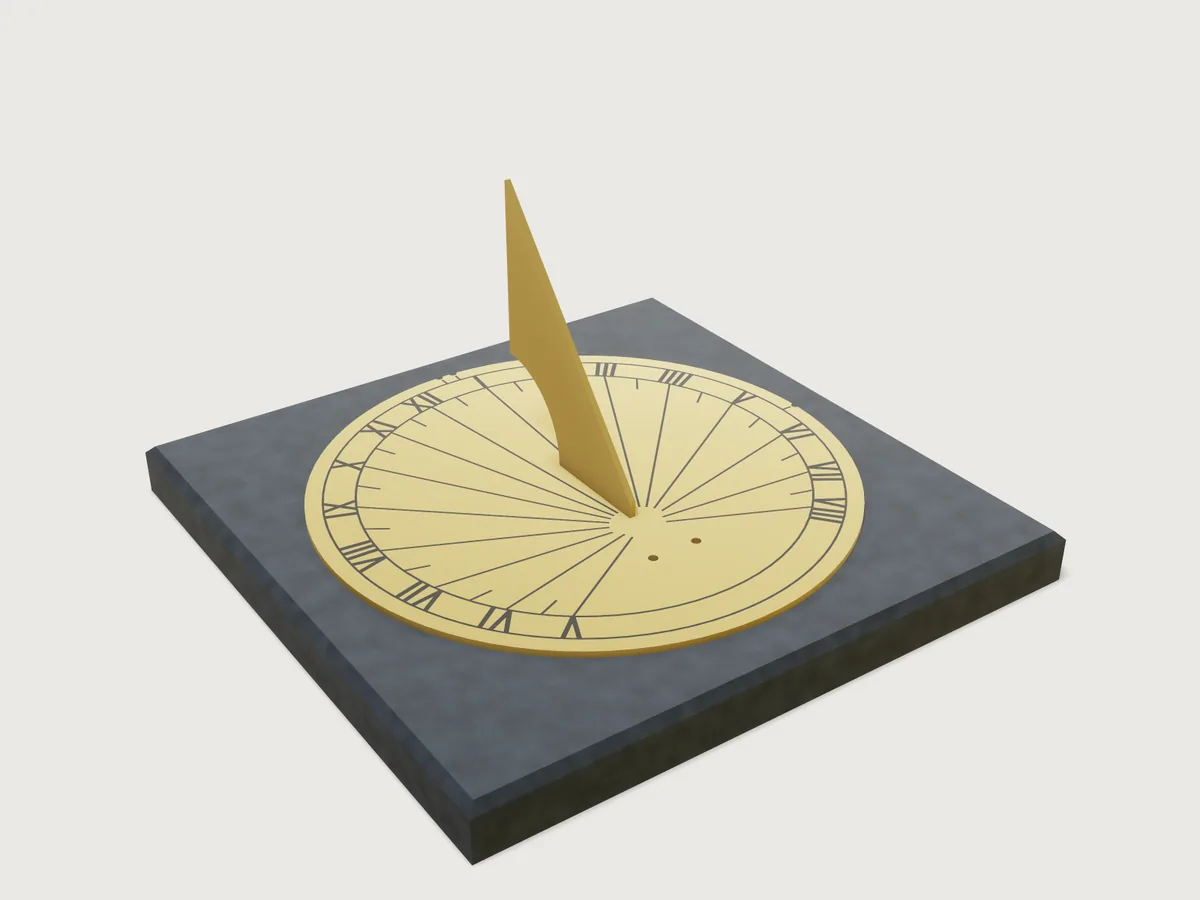
A brass sundial on slate, drawn for the place where it will stand: a horizontal dial for a pedestal in the garden, or a vertical dial for a wall, also a wall that does not face due south. Pick a city or give your latitude, longitude and time zone, and the hour lines are laid out so that the dial reads the clock time of your zone: the longitude correction is in the lines, the equation of time is in the form's description. The gnomon's thickness is handled as a real dialist does it, with two styles and a noon gap. The brass plate and gnomon go to a laser or waterjet from one named set, drawn as the beam's path for your kerf, the engraving (lines, ticks, numerals and the chapter ring) from another, placed by a measure on the form or by three notches in the plate's edge that it fits one way only; the slate is a stone supplier's slab or plaque.
What it shows
- Formulas that draw an instrument (
variable.set,sketch.polyline). Each hour line's angle is the textbook construction of a plane dial: a horizontal dial for the latitude SH (the style height), turned by the substyle angle SD, with its hours counted from the substyle's own hour angle. One family of formulas covers the horizontal dial, the south wall and every declining wall. - The form changes what is built. The hours that get a line follow the place: 13 or 14 lines at 25° N on a pedestal, 18 or 19 at 65° N (by the longitude), 9 to 13 on a wall depending on where it faces; the time zone moves them by the longitude correction, and when an hour falls exactly on the substyle the noon line is doubled, one on each side of the gnomon. The wall dial stands upright on its slate plaque and the plaque gets four fixing holes; the pedestal dial lies on a slab.
- Datum planes from formulas (
datum.planethrough three points). The plane of the dial is set horizontal or upright, and the gnomon's plane stands on the substyle, by expressions; every sketch of the dial is drawn in one frame whose y axis is the substyle. - An engraving that exports as one drawing (
set.define,file.exportof a set). The chapter ring, the hour lines, the half-hour ticks and the numerals touch each other, so the engraving is one region, which a named set exports as one drawing; the cut sheet is the plate's face and the gnomon's side. The output Engraving inset places one on the other, and three notches with three index marks let a cut plate take the engraving one way only. - The beam's path in the bodies (
feature.offsetProfile). The plate's and the gnomon's sketches are the parts as they come out; each is offset by half the kerf before it is extruded, outlines out and slots and holes in, so the named set Cut sheet is what the laser follows, and the form's Laser kerf changes the file the maker exports. - Numerals drawn letter by letter (
sketch.polyline): each letter of a Roman numeral is a polygon set upright on the chapter ring, sized so that the widest numeral, VIII, fits between the two closest hour lines. - Assertions that rebuild the dial another way (
assert.add): the shadow of the gnomon's edges is constructed with vectors from the latitude, the wall's direction and the sun's hour angle, and the model's style, lines and noon lines must lie where that shadow falls.
A static model of a sundial is right for one place and one wall. This one is right for any place from 25 to 65 degrees north and any wall up to 50 degrees from south, and says which hours the sun can reach.
The real thing
The hour lines. With φ the latitude, d the wall's declination from south (west positive), h the hour angle (15° per hour from local noon, afternoon positive):
| Style height SH | Substyle angle SD (from the noon line) | Hour line angle X (from the noon line) | |
|---|---|---|---|
| Horizontal | φ | 0 | tan X = sin φ · tan h |
| Vertical, declining | sin SH = cos d · cos φ | tan SD = sin d / tan φ | tan X = cos φ · tan h / (cos d + sin d · sin φ · tan h) |
These are the formulas of Carl Sabanski's The Sundial Primer (mysundial.ca), pages Horizontal Sundial and Vertical Declining Sundial, which were read; Wikipedia's Sundial gives the same three for the declining dial in another form. The model draws a declining dial differently, as the classical construction does: every line makes the angle ψ with the substyle, tan ψ = sin SH · tan (h − DL), where DL is the substyle's hour angle, the "difference in longitude", cot DL = cot d · sin φ (Wikipedia, Schema for vertical declining dials, after Waugh, Sundials: Their Theory and Construction, pp. 78–79; the Wikipedia page was read, Waugh was not). The independent check below holds the model to the Primer's formula.
Which hours. A line is drawn for every clock hour at which the sun shines on the dial on some day of the year: for some declination of the sun between −23.44° and +23.44° (the mean obliquity at J2000.0, 23°26′21″, Wikipedia Axial tilt) it is above the horizon and in front of the dial. Each of the two conditions holds on half a turn of the declination, so the test is closed: the largest lower end of the two half-turns and of the year against the smallest upper end. On a pedestal it is the sunrise and sunset of midsummer. Lines stop 9 hours from local noon (3 a.m. to 9 p.m. solar time): north of 58.5° the midsummer sun is up longer, and those hours have no line. On a declining wall some of the first or last lines are reached only for some weeks of the year, at a low sun or a grazing angle; they are drawn, since the sun does reach them. On a wall facing due south in solar time the 6 and 18 o'clock lines, along the horizontal through the root, are reached only at a grazing angle at the equinoxes; they are drawn, as on most south dials, where they close the hours.
A thick gnomon. The gnomon is cut from the dial's sheet, so it is as thick as the plate, and both of its top edges are styles. From 6 a.m. to noon the shadow's edge is cast by the western style, from noon to 6 p.m. by the eastern one; before 6 a.m. and after 6 p.m. by the other one (British Sundial Society, How sundials work, part 4: "after 6 in the afternoon, and before 6 in the morning, the shadow will be coming from the other style"). So the morning lines start on one side of the gnomon's root and the afternoon lines on the other, a gnomon's thickness apart (the noon gap), and the early and late lines change side. On a declining wall the change is at the substyle's hour DL and 6 hours either side of it, not at noon and 6. When an hour falls exactly on the substyle (noon on a pedestal or a south wall in solar time, or with your longitude on the zone's meridian), both styles cast it: it gets a line along each face of the gnomon.
The layout. The root sits behind the centre of the disc: on a wall 45 % of the radius, on a pedestal 28 % in the north, where lines run all round, up to 45 % in the south, where few hours lie behind the root. Lines are 0.4 % of the diameter wide (0.6 to 1.2 mm); they start where neighbours are two line widths apart (at least 5 % of the diameter from the root), and a line that would run along the gnomon's foot starts where it has left a band of the slot's width and a line width either side of it, or beyond the foot's end, so that nothing engraved runs under the gnomon and no line is cut lengthwise; they end on the inner ring of the chapter band, the half-hour ticks 4.5 % of the diameter long. The numerals stand between the two rings, upright on the outside of a pedestal dial and hanging from the outer ring on a wall, so that noon reads the right way up. The gnomon reaches 70 % of the way from the root to the ring, but no higher than half the diameter (a high style is shorter), with its front cut square at 6 % of its length but never lower than the sheet is thick, and a quarter-round hollow under its back; two tabs under its foot sit in slots through the plate. Three notches are cut in the plate's edge: a pair at the top (north on a pedestal, up on a wall) and one at the right (east). As cut, each is a circle of 2 mm radius about a point of the rim (half the sheet plus 0.5 mm in sheet over 3 mm), so it is wider than the sheet. The pair's centres are four notch radii apart. The engraving has three index marks, which point at the notches. Two notches 180° apart, as an earlier version had, also fit a plate turned half a turn or turned over. These three fit no turn of the plate and no turning over but the right one; on a declining wall either mistake would put the lines' root away from the slots.
Clock time. In clock time the lines are moved by the longitude correction, 4 minutes for every degree between your longitude and your zone's meridian (15° times its hours from UTC); the output Longitude correction gives it. The sun also runs ahead of and behind the clock over the year, the equation of time: add these minutes to the dial's reading to get standard time (from NOAA's General Solar Position Calculations, read; within about a minute in any year), and an hour in summer time.
| Jan | Feb | Mar | Apr | May | Jun | Jul | Aug | Sep | Oct | Nov | Dec | |
|---|---|---|---|---|---|---|---|---|---|---|---|---|
| 1st | +3 | +13 | +13 | +4 | −3 | −3 | +4 | +7 | 0 | −10 | −16 | −11 |
| 15th | +9 | +14 | +10 | 0 | −4 | 0 | +6 | +5 | −5 | −14 | −15 | −5 |
The table is not engraved on the dial: a table of numbers would be separate regions of the engraving, which a named set cannot export in place (see Platform notes). It is in the description of Time shown, on the form.
Making it.
- Brass. CuZn37 (CW508L) sheet of the thickness on the form; at least 1 % of the diameter, a rule of thumb of this Jig so that the gnomon stays stiff, not a calculation. On a laser, set Laser kerf to the laser's kerf (at most 0.2 mm, a fibre laser's) and cut the dial plate and the gnomon from the set Cut sheet with the laser's own kerf compensation off: the file is the beam's path. A waterjet cuts wider than the form's range: set Laser kerf to 0, so the file is the parts' true outline, and switch the machine's own kerf compensation on. As cut, the slots are 0.2 mm wider and 0.5 mm longer than the tabs, so a slot is never narrower than the sheet, and the tabs stop 0.2 mm short of the plate's back. The plate's two holes take M4 screws (4.5 mm, ISO 273 normal series), M5 (5.5 mm) in 5 mm sheet, so that no hole is narrower than the sheet. Break every cut edge with a file or a deburring tool, but keep the gnomon's two top edges sharp: they are the styles. The edges are not chamfered in the model, since the cut sheet is the parts' faces and a chamfer would move their outlines.
- Engraving. Engrave the set Engraving into the plate's face, 0.2 to 0.3 mm deep with a fibre laser or a rotary cutter of the line width, fill it with black engraving wax or paint and rub the face back; lacquer it if it should stay bright. Place it in one engrave-and-cut job by the output Engraving inset, or on a cut plate by the three index marks and notches (see Export).
- Gnomon. Push the tabs through the slots, square the gnomon to the plate with a set square on both sides (the slots leave 0.2 mm of play), and solder the tabs from behind: silver solder outdoors, soft solder only for a dial under cover.
- Slate. A slab of 25 mm (pedestal) or a plaque of 20 mm (wall), square, 12 % of the diameter plus 20 mm larger than the dial, with a 4 mm bevel on the face. Drill and plug two holes for the brass screws through the dial; a wall plaque hangs on four M6 screws (6.6 mm holes, 20 mm in from the corners). Bed the plate on a flexible adhesive: CuZn37 expands by 19 × 10⁻⁶ per kelvin (Deutsches Kupferinstitut), 0.3 mm over 50 K on a 300 mm plate, which a rigid bed would fight.
- Setting it up. Bed the plate square on the slate: the pair of notches at the middle of the slate's top (north) edge, the single notch at the middle of its right (east) edge. A pedestal dial: level the slab in two directions, and turn it so that the gnomon lies on the meridian, its high end and the pair of notches to true north (the Pole Star), not magnetic north; or turn it until the gnomon casts no shadow to either side at solar noon, which on the clock is 12:00 plus the output Longitude correction, plus the equation of time above, plus an hour in summer. A wall dial: measure the wall's direction first (a compass corrected for the magnetic declination, or the shadow of a plumb line at solar noon), and hang the plaque level, with a spirit level on its top edge; the gnomon points down and out, towards the south celestial pole.
Parameters
| Group | Parameter | Range | What it changes |
|---|---|---|---|
| Your place | Place | 12 cities or Custom | latitude, longitude, time zone (coordinates read from Wikidata; the standard UTC offsets, CET +1, GMT 0, EST −5, JST +9, are common knowledge) |
| Your place | Latitude (Custom) | 25° to 65° N | every line, the style height, the hours the sun reaches |
| Your place | Longitude (Custom) | within 30° of the zone's meridian | the longitude correction |
| Your place | Time zone (Custom) | UTC −10 to +12 h | the zone's meridian |
| The dial | Dial | horizontal / vertical | pedestal or wall: the line family, the gnomon, the slate |
| The dial | Wall direction | ±50° from south, less north of 55° | the substyle, the style height, which hours |
| The dial | Time shown | clock time / local solar time | the longitude correction in or out of the lines |
| The dial | Dial diameter | 180 to 400 mm | everything in proportion; numeral size |
| Making it | Brass sheet | 1 % of the diameter (at least 1.5 mm) to 5 mm | plate and gnomon thickness, slots, noon gap |
| Making it | Laser kerf | 0 to 0.2 mm | the beam's path: outlines half a kerf out, slots, holes and notches half a kerf in (0 for a waterjet, which compensates itself) |
The wall direction's limit keeps sin SH ≥ 0.35: further round, the style lies so flat and the noon lines crowd so much that the numerals would no longer fit between them.
Outputs: longitude correction (minutes after 12:00 that the sun is due south), style height, gnomon height, number of hour lines with the first and the last, numeral height, slate size, the engraving inset (how far the engraving's box lies inside the plate's, from the left and the bottom), brass volume and mass (CuZn37, 8.44 g/cm³, Deutsches Kupferinstitut data sheet). At the defaults (Brussels, pedestal, clock time, 250 mm, 3 mm): 42.6 minutes, 50.8°, a gnomon 125 mm high, 16 lines from 5 to 20 o'clock, numerals 13.75 mm, a slate 300 mm square, an inset of 7.55 mm, 1.37 kg of brass; the cut sheet (beam path for a 0.1 mm kerf) is 351 by 250 mm and the engraving 239.5 by 239.5 mm, the index marks reaching beyond the ring at the top and the right.
Checks
Twenty-one assertions, measured on the model at every change of the form. The first seven build the dial a second way: the shadow of the gnomon worked out with vectors in the world (east, north, up), from the latitude, the wall's direction, the sun's hour angle at the clock hour (from the longitude and the time zone again, not from the model's longitude shift) and the gnomon's thickness, without the style height, substyle angle, substyle hour angle or any frame the model is drawn in. The style g points to the celestial pole (on a wall, the south pole); the sun's equatorial direction is E = (−sin h, −cos h sin φ, cos h cos φ); on the dial plane with normal n the shadow of the style runs along (E·n) g − (g·n) E, the same at every date; of the two styles, the one between a lit and an unlit face of the gnomon casts the shadow's edge (the top face is lit when E·n > 0, a side face when E points to its side).
- The style lies on the polar axis through the root: the four ends of the gnomon's two top edges lie, within 0.02 mm, where the polar axis through the root puts them, at the mitres of the beam's path half a kerf outside the style.
- to 5. The 5, 7, 10 and 15 o'clock lines lie where the shadow of the gnomon falls: the two outer corners of each line, where its edges meet the chapter ring, lie within 0.02 mm of the shadow construction's (top and bottom of the wax, four vertices); or the line is absent when the sun does not reach that hour. A line turned by 0.01° to 0.03° (by its length) or moved sideways by 0.03 mm fails. The 5 o'clock line, before 6 a.m., checks that the other style casts it.
- The half-hour ticks at 9:30 and 13:30 lie where the shadow falls, the same way.
- The numerals V, VII and X stand at their hour lines: the crotch of the V of V and of VII and the upper crotch of X, corners that lie inside the chapter band, are where the construction's line end, seen from the centre, and the letter's place in its numeral put them. A numeral turned along the ring or standing at another hour fails.
- With an hour on the substyle, a noon line along each side of the gnomon (only then): eight vertices at the construction's places.
- One line for every hour the sun reaches the dial: the wax has four long straight edges per hour line (the edges a tick, a numeral, an index mark or a ring makes are shorter, or circular), as many as the hours the form's rule switches on, plus the twin noon line. Lines that should not be there are moved off the dial by their formulas and cut away by the engraving's mask; this proves that none stays and none is lost.
- Lines 0.4 % of the diameter wide, 0.6 to 1.2 mm: the distance between the two long faces of the 10 o'clock line.
- The engraving is one region, so that its named set exports as one drawing.
- The engraving's box starts at the outer ring: its left edge is the outer ring's outside edge (the bottom edge is the same circle's). With assertion 14 this is what the output Engraving inset rests on.
- The index marks point at the three notches: the twelve corners of the marks' ends (top and bottom of the wax) lie, within 0.02 mm, a millimetre short of the notches, on the lines from the centre to the notches' centres.
- The plate is drawn half a kerf outside the dial: its box's left edge lies at the radius plus half the kerf. 15., 16. The slots are drawn as the sheet plus 0.2 mm, and the tab plus 0.5 mm, less the kerf: the distances between the slot's walls, so they come out at the sheet plus 0.2 mm and the tab plus 0.5 mm; since the kerf is at most 0.2 mm (its range), a slot never comes out narrower than the sheet, and the gnomon's tabs, drawn a kerf longer, keep at least 0.1 mm free.
- The screw holes are drawn as their clearance hole less the kerf, and never narrower than the sheet as cut (M5 in 5 mm sheet).
- Three notches, a pair at the top and one at the right, each wider than the sheet: three faces of the plate's edge with the notch radius less half the kerf, each inside a box around its own place on the rim, and each, as cut, at least half the sheet plus 0.25 mm in radius (the notch's width at the rim is then more than the sheet).
- The gnomon's tabs reach to 0.2 mm short of the plate's back: eight tab corners there, half a kerf lower as drawn.
- No part overlaps another: the gnomon and the plate against the wax and the slate. The gnomon's beam path along its foot lies half a kerf into the plate, as the beam's path does, and is left out.
- Numerals at least 4.5 mm high.
What holds the form to the dial: the latitude stops at 25 and 65° N; the wall's direction at the angle where sin SH falls to 0.35 (50°, but 45.6° at 60° N and 34° at 65° N); the brass sheet at 1 % of the diameter; the longitude within 30° of the zone's meridian. The numerals take the largest size at which the widest one fits between the two closest lines with two line widths to spare, at most 5.5 % of the diameter: a replica of the layout run over latitude, wall direction, longitude and size found the narrowest gap between numerals 1.10 times the widest numeral plus a line width (on a 400 mm wall dial at 51° N turned 50° east, the clock 1.8 hours off the sun).
Range. tools/jigs.py check runs check-range: 111 points (the defaults, 64 corners of the box of the ranges, every
choice, 32 random from seed 1), all passing and none unproven; the slowest took 0.30 s and the mean 0.22 s
(meta.json; budget for the slowest point 12 s). The opening time is the tool's, stats.load_s in meta.json: 1.29 s
(budget 4 s). The file is 879 KB.
Beyond it, during the build:
- A scan of the form, 300 points set with
param.setin one session and checked withdocument.check: 84 at the corners that matter (latitude 25, 40, 52, 60 and 65°, pedestal and wall, the wall at both limits and at south, the longitude 30° either side of the zone's meridian and on it, 180 and 400 mm, the thinnest and thickest sheet) and 216 random; and 198 points where an hour falls exactly on the substyle (every 5° of latitude, longitudes a whole number of hours off the meridian, both dials, both sizes). All passed on the model before the notches changed; on the model as it stands the 84 corners and 60 more random points were scanned again, and all pass. An earlier scan found 5 mm sheet with 4.5 mm holes (now M5 holes) and a miscount where the gnomon's keep-out cut a line lengthwise (lines now start clear of it);check-rangefound a twin noon line drawn onto its own hour line when the substyle's hour came out a rounding error below zero (the twin now takes the side opposite its hour line's); the review found the kerf-compensated cut file ofcut.exportmirrored on every wall dial (the kerf is now in the bodies); andcheck-rangethen found the style and tab checks counting both ends of a rounded beam-path corner at kerfs of 0.03 mm (the corners are now mitred). The scans now draw the kerf at random from 0 to 0.2 mm. - An independent check of the exported files (an unpublished check: its script is not in this repository): at 24 points (all twelve cities, the corners of latitude and longitude, walls at ±50° and at the northern limit, 180 to 400 mm, both kinds of time) it exports the sets Engraving and Cut sheet and matches every straight edge of the engraving against the shadow construction above, computed again in the script with a dense sweep of the sun's declination through the year, and against the Sundial Primer's hour line angles. It also places the two files the way Export below says: the plate's rim lies on a circle about the point R + k/2 in from its box's left and bottom edges, and the outer ring on one about the point (outer ring plus half a line) in from the engraving's (to 10⁻¹³ mm), so the Engraving inset puts the two centres together. It finds the three notch centres on the rim and the three marks' ends, and tries every turn of the plate, face up and turned over: the marks point at the notches at one turn only, face up, at all 24 points. Every hour line and half-hour tick lies within 0.0001 mm and 0.00001° of the shadow of the right style, with both its edges; no edge is left unexplained, so no line stands where the sun never shines; the Primer's angles agree with the vectors to 10⁻¹³ degree; the only hours the sun reaches without a line are those more than 9 hours from noon at 64 and 65° N. An earlier version of the hour rule (the sun up at midsummer and, on a wall, in front of it at the equinox) drew a 5 a.m. line on a wall in Leuven turned 25° east, which the sun never reaches; the rule is now the closed test above.
- Mutation tests: twenty-six faults in a scratch copy, each caught by at least one assertion, at the defaults or at one of four other points (solar time; a wall 30° west with a 0.2 mm kerf; Madrid on a wall 40° east; 180 mm in 5 mm sheet with a 0.2 mm kerf): the hour angle with cos SH for one line, with sin² SH for all; the style for a line from the sign of sin x instead of the BSS rule; the substyle angle, its hour angle and the longitude correction each the wrong way; the style height 1° off; the gnomon's plane 1 mm off the root; the tabs 0.5 mm short; slots 0.2 mm narrower than the sheet; the engraving mask too large, so the parked marks stay; no twin noon line; the outer ring line 1 mm too wide; the screw holes drawn 10 % small; the hours the sun does not reach left on the dial; numerals that do not reach the outer ring; lines that start under the gnomon; the numeral VII turned 4° along the ring; the 13:30 tick drawn at 13:36; lines 20 % thin; no kerf in the plate; a whole kerf instead of half on the gnomon; the notch radius a fixed 2 mm (caught in 5 mm sheet, where the notch would be narrower than the sheet); the single notch 10° off the right; its index mark at the left; the index marks 1 mm short. The reviewer's own twelve mutations were run again on the model before the notches changed (they touch none of the notch geometry): the numeral VII turned 4°, VII and VIII swapped, the 13:30 tick at 13:36 and lines 20 % thin, which survived before, are now caught (the numeral faults at the three points where 7 o'clock has a line). Two of them still survive by design: an obliquity of 20° and the 9-hour limit cut to 8 hours change which hours get a line, and that rule is checked by the script, not by an assertion (the count follows the rule it is given).
Not proven on the model: the hour lines other than 5, 7, 10 and 15 o'clock, the ticks other than 9:30 and 13:30, and the numerals other than V, VII and X (the count proves how many lines there are, assertion 11 that every numeral touches both rings, and the script where every line and tick lies, at its 24 points); which hours get a line (the model's rule is checked by the script, not by an assertion); the stiffness of the gnomon, the solder joint and the screws.
Export
- Laser or waterjet: File › Export, Sheet of set: Cut sheet, as DXF or SVG: the dial plate (its outline with the three notches, the two slots for the gnomon and the two screw holes) and the gnomon with its two tabs, side by side, each on a layer of its own. The file is the beam's path for the form's Laser kerf: outlines half a kerf out, slots, holes and notches half a kerf in, outside corners carried on to a sharp mitre. On a laser, cut it with the laser's own kerf compensation off; on a waterjet, export it with the kerf at 0 and let the machine compensate.
- Engraver: File › Export, Sheet of set: Engraving: one region, the area to engrave (the two rings of the chapter
band, the hour lines, the half-hour ticks, the numerals and three index marks), at true size. Both files are drawn the
same way up and from the front (north up for a pedestal dial, up the wall for a wall dial), so the engraving sits on
the plate by a shift alone. Two ways to make it:
- One job, engrave then cut, on a laser that does both: import both files, and move the engraving so that its box's left and bottom edges lie the output Engraving inset inside the left and bottom edges of the plate's outline (the layer Dial plate), for example with the laser software's numeric position. The left and bottom edges of both boxes are the rim and the outer ring, circles about the dial's centre, with no notch or mark there (assertions 12 and 14). Engrave, then cut.
- A plate already cut, under a galvo head or on an engraver's table: lay the plate face up and frame the job so that the three index marks point at the three notches, the pair at the pair. They fit at one place and one turn only, and not at all on a plate turned over.
- 3D: File › Export of the bodies as STEP, for a check of how the parts sit.
The README in the model's repository has the rest (Files, Rebuild, Difficulty, Platform notes, Licence): the whole README on GitHub.